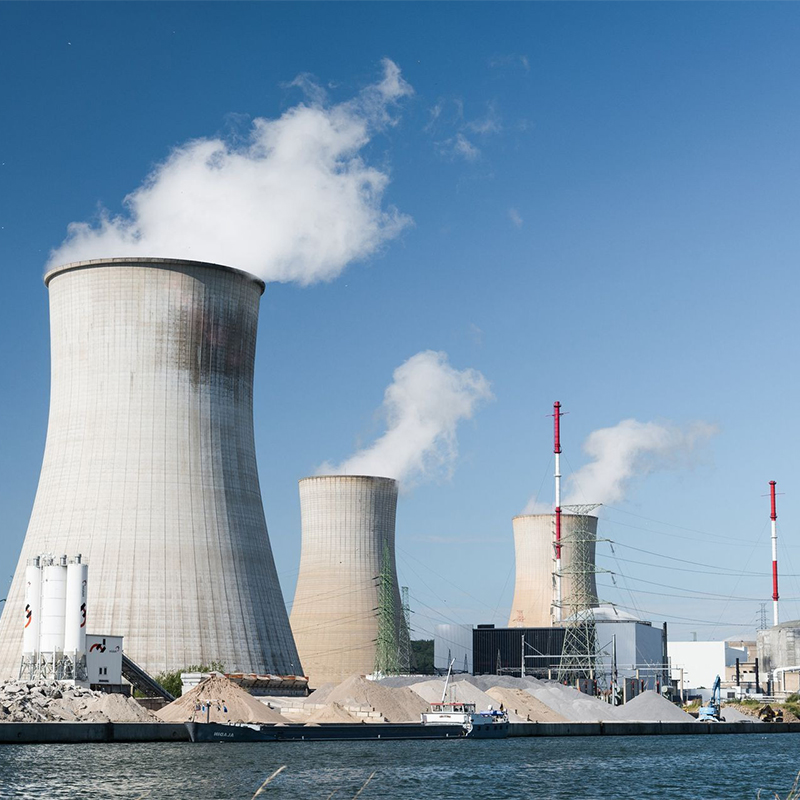
We Provide Cooling Tower Solution

Views: 0 Author: Site Editor Publish Time: 2025-11-27 Origin: Site


A cooling tower is a heat-exchange device that releases waste heat from a system into the atmosphere through water–air heat transfer. Hot water from industrial processes or HVAC systems is pumped into the cooling tower, where it comes into contact with air through spraying and fill media. As part of the water evaporates, heat is carried away, lowering the temperature of the remaining water. The cooled water then returns to the system for reuse.
Cooling towers are widely used in power plants, chemical plants, factories, and commercial buildings. Since different applications require different designs, a variety of cooling tower types have been developed. Understanding these classifications is essential for selecting the right model and achieving energy-efficient cooling.
Cooling towers can be classified according to several criteria:
| Classification Dimension | Meaning / Difference |
|---|---|
| Airflow / Ventilation Method | How air flows through the tower: natural draft or mechanical draft. |
| Air–Water Flow Pattern | Air and water flow directions — cross-flow or counter-flow. |
| Heat-exchange Method | Whether water directly contacts air: wet, dry, hybrid. |
| Manufacturing / Structure Type | Factory-assembled or field-erected. |
By combining these classification dimensions, many cooling tower types can be identified. The following sections introduce the most common ones.
Natural draft cooling towers rely on the natural chimney effect created by temperature differences between hot and cold air. They typically feature tall hyperbolic shells to enhance upward airflow.
No fan required → very low operating cost
Ideal for large-scale industrial cooling
Long service life and low maintenance
Large structure, high construction cost
Not suitable for urban or space-limited environments
Only practical for large facilities such as power plants
Mechanical draft cooling towers use fans to force or induce airflow.
Induced Draft Cooling Tower:
Fan installed at the top to pull air upward
High cooling efficiency and less air recirculation
Widely used in HVAC and industrial systems
Fan located at the air inlet to push air into the tower
Suitable for indoor or ducted installations
Air recirculation risk slightly higher; energy consumption higher
Mechanical draft towers are the most common type due to their flexible design and installation convenience.
Air enters horizontally; water falls vertically.
Simple structure, low air resistance, lower fan power.
Suitable for sites with limited height but adequate ground space.
Air rises upward against the downward water flow.
Higher heat-exchange efficiency and smaller footprint.
Slightly higher fan power due to higher air resistance.
Cooling towers can also be classified according to how heat is removed and whether water directly contacts air:
Water directly contacts air
Evaporative cooling → highest efficiency
Most common type
Uses coils / heat exchangers
No evaporation; no water loss
Ideal for areas with scarce water supply or strict water-quality requirements
Combines wet and dry modes
Saves water while maintaining cooling capacity
Higher cost but suitable for modern energy-efficient systems
Open-circuit: Water is exposed to air; high efficiency
Closed-circuit: Water circulates inside coils; no contamination, easier to maintain
Different cooling tower types have different advantages and limitations. Below is a comparison:
| Type | Advantages | Disadvantages |
|---|---|---|
| Natural Draft | Low operating cost; ideal for large-scale cooling | High construction cost; huge structure |
| Induced Draft | High efficiency; less air recirculation | Requires fan maintenance |
| Forced Draft | Flexible installation | Higher energy usage; possible recirculation |
| Cross-flow | Simple maintenance; low fan power | Larger footprint |
| Counter-flow | Higher efficiency; compact design | Higher air resistance; higher fan power |
| Wet | Best cooling efficiency | Uses more water; requires water treatment |
| Dry / Closed-circuit | Saves water; protects water quality | Higher cost; lower efficiency |
| Hybrid | Combines efficiency and water saving | High complexity and cost |
If you are considering purchasing cooling towers from a manufacturer such as MachCooling (https://www.machcooling.com/), understanding the above types is essential.
For large industrial plants or power stations, natural draft or large induced-draft counter-flow towers are typically preferred.
For commercial buildings or light industrial uses, factory-assembled mechanical draft towers—cross-flow or counter-flow—are widely used.
For regions with water scarcity, closed-circuit or dry/hybrid towers may be the best choice.
With knowledge of these classifications, you can communicate your needs more clearly to the manufacturer.
Cooling towers cannot be simply categorized into only a few types. They are classified by:
Ventilation method
Air–water flow pattern
Heat-exchange method
Structural type
Selecting the right cooling tower requires consideration of cooling load, water availability, spatial constraints, operation cost, and maintenance capacity.
Understanding these categories makes it easier to choose the right model and helps streamline communication with suppliers such as MachCooling.