We Provide Cooling Tower Solution

Views: 0 Author: Site Editor Publish Time: 2026-02-11 Origin: Site


Cooling towers are essential workhorses of industrial and commercial HVAC systems. Whether you’re running an industrial plant, a power station, or a large commercial complex, cooling towers keep processes and environments in balance. But here’s a question you might not think about every day: what are cooling towers made of, and why does it matter?
Materials are the backbone of any engineered system — they determine how long something lasts, how well it performs, and how much it costs to own and operate. In the world of cooling towers, lightweight and corrosion-resistant composites have revolutionized how these structures are designed and deployed, outperforming traditional steel or concrete options in many scenarios.
Let’s explore why composites are such a big deal in cooling tower technology — and why manufacturers like Mach Cooling (https://www.machcooling.com/) have embraced composite solutions for modern systems.
When you think of cooling towers, you probably imagine tall structures set against a factory skyline. What you might not see — but absolutely affects performance — is what’s inside those walls: the materials that resist water, heat, and corrosion day after day, year after year.
Traditional materials like steel can rust. Concrete can crack and degrade. Composites — materials made from two or more constituents — are engineered to overcome those issues at their core.
Composites are engineered materials made by combining two or more different substances to achieve properties that individual components can’t provide alone. Think of fiberglass — glass fibers embedded in a resin matrix — combining strength with flexibility.
Metals like steel are strong, yes. But they’re heavy and prone to corrosion in wet environments like cooling towers. Composites, by contrast, are designed to be lightweight, corrosion-resistant, and durable — a big advantage when dealing with water, wind, and heat.
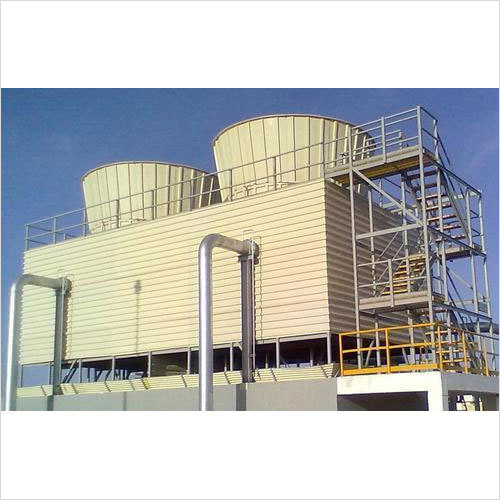
FRP is the most widely used composite in cooling tower applications. It’s a blend of strong fiberglass reinforcements and a plastic resin matrix.
The glass fibers provide strength without adding weight, and the plastic resin keeps things from corroding. Put together, FRP structures can be up to 70% lighter than steel equivalents.
Water, humidity, and chemicals are constant threats in cooling towers. FRP doesn’t rust, rot, or degrade like steel or wood — giving it a longer effective life with less maintenance.
Some modern towers use polymers tailored to resist specific chemical environments or temperature ranges, further improving longevity and performance.
These combine different fibers or fillers (like carbon fiber in an FRP mix) to boost strength and stiffness where needed.
Lightweight towers put less strain on foundations and supports. That means simpler, cheaper structural engineering.
Heavy steel towers require cranes, rigging, and large crews. Composite towers can often be assembled faster, with smaller teams — saving time and labor cost.
Less weight equals lower freight costs, and many composite cooling towers can be modular — shipped in pieces and assembled onsite.
Cooling towers deal with moisture, chemical treatments, and continuous operating cycles. In steel towers, corrosion eats at metal over time, leading to leaks, weakened structure, and expensive repairs.
Composites like FRP don’t rust. They resist chlorides, sulfates, and other corrosive agents that attack metals, making them ideal for coastal locations, chemical plants, or systems treating municipal water.
Composites can be engineered with thermal conductivity properties that promote efficient heat exchange without degrading under constant thermal cycling.
Unlike wood or metal, composites don’t warp or crack when wet, and they resist chemical attack — a huge benefit where blowdown treatment chemicals or industrial pollutants are present.
Composites allow architects and engineers to design shapes and forms that would be difficult or expensive with traditional materials. That means optimization for airflow, noise reduction, and even aesthetics.
Because they resist rust and decay, composite towers often outlast steel or wood equivalents, delivering a better return on investment over the lifecycle.
Less corrosion means fewer repairs. That translates into lower lifetime costs and fewer operational headaches.
Factories, power plants, and processing facilities often operate harsh environments with high heat loads and corrosive conditions — the perfect use case for composites.
Large buildings like malls, hospitals, and office complexes use composite towers to ensure dependable cooling with minimal maintenance disruption.
Sea air and salt spray can wreak havoc on steel. Composite towers excel here, making them a go-to choice near coastlines and ports.
In a chemical processing facility, composite towers replaced aging steel units. Not only did corrosion resistance improve, but the lighter weight reduced foundation costs and downtime during installation.
At a seaside resort’s HVAC plant, composite cooling towers have resisted salt-air corrosion for years, avoiding frequent repainting and structural repairs.
Selecting a cooling tower supplier isn’t just about picking the lowest bid. You want:
Proven engineering expertise
Material quality verification
Design customization options
Reliable after-sales support
Look for manufacturers with ISO certifications, rigorous testing protocols, and a track record of long-term performance.
Mach Cooling (https://www.machcooling.com/) has built a reputation for delivering high-performance composite cooling towers engineered to meet a wide range of industrial and commercial needs.
Mach Cooling offers FRP and hybrid composite towers, tailored designs, installation guidance, and comprehensive service packages — helping clients get the best performance over the long haul.
The field of composites is evolving fast. Look for:
Next-generation polymers with even better thermal performance
Smart composite materials with embedded sensors
Eco-friendly resins and recycling pathways
Modular designs that simplify upgrades or capacity expansion
When it comes to cooling tower performance, materials matter. Lightweight, corrosion-resistant composites deliver unmatched advantages — from easier installation and lower maintenance to superior longevity and cost savings. With trusted manufacturers like Mach Cooling, adopting composite tower technology is a smart way to future-proof your cooling infrastructure.
1. Why are composites preferred over steel for cooling towers?
Composites resist corrosion, are lighter, lower maintenance, and often last longer than steel in harsh environments.
2. What is the most common composite used in cooling towers?
FRP (Fiber-Reinforced Plastic) is the most widely used due to its balance of strength, weight, and corrosion resistance.
3. Can composite cooling towers handle coastal environments?
Yes — composite materials excel in salt-laden, humid, and corrosive coastal conditions.
4. Do composite towers cost more upfront?
They may have a higher initial cost, but lower maintenance and longer life often make them more cost-effective over time.
5. How do I choose the right composite cooling tower manufacturer?
Look for experience, certification, material quality, customization capabilities, and strong after-sales support — qualities offered by reputable manufacturers like Mach Cooling.