We Provide Cooling Tower Solution

Views: 0 Author: Cindy Publish Time: 2026-09-24 Origin: Site


If you're looking for a 400 ton cooling tower, you will quickly come across two major configurations: counterflow and crossflow.
So, which one should you choose?
At first glance, both towers do the same job. They remove heat from circulating water and transfer that heat into the atmosphere. But the way they move air and water is different, and that difference can affect the tower's footprint, water distribution, maintenance, energy consumption, winter operation, and overall project cost.
In other words, choosing between a 400 ton counterflow cooling tower and a 400 ton crossflow cooling tower isn't simply about deciding which design is “better.”
The real question is:
Which design is better for your application?
Let's compare the two designs step by step.
Before comparing counterflow and crossflow, let's clarify what “400 ton” actually means.
A 400 ton cooling tower is rated according to its nominal cooling capacity. The word “ton” refers to cooling capacity, not the physical weight of the equipment.
That distinction is important.
A 400 ton cooling tower may look different from another 400 ton tower because actual design conditions can vary. Water flow, entering-water temperature, leaving-water temperature, cooling range, approach, and design wet-bulb temperature all influence the final tower selection.
So, if a supplier asks you for more information after you say, “I need a 400 ton cooling tower,” that's a good thing.
A professional cooling tower manufacturer should want to know more.
Think of the 400-ton rating as the size of the thermal job the tower is expected to handle.
It's a little like buying a truck based on its payload rating. The payload number is important, but it doesn't tell you everything about the vehicle's performance.
You still need to know how far the truck will travel, what roads it will use, and what conditions it will face.
The same principle applies to cooling towers.
A 400 ton tower designed for one set of operating conditions may require a different configuration when the project has different water temperatures or a different design wet-bulb temperature.
That's why capacity should always be considered together with actual operating conditions.
A 400 ton cooling tower can be suitable for a wide range of cooling applications.
Typical applications may include:
Industrial process cooling
Manufacturing plants
HVAC and chiller systems
Plastic processing
Metal processing
Chemical plants
Heat exchangers
Compressors
Industrial machinery
Power-related equipment
The application matters because different industries have different cooling requirements.
A clean HVAC system, for example, may have very different water-quality requirements from a steel-processing facility.
That's where the choice between counterflow and crossflow becomes more meaningful.

The basic difference between these two designs is the direction in which air and water move.
In a counterflow cooling tower, air generally moves upward while water flows downward.
In a crossflow cooling tower, air moves horizontally across the falling water.
It sounds simple.
But this basic difference influences the tower's internal design and operating characteristics.
The water-distribution system, fill arrangement, airflow path, maintenance access, and installation footprint can all be affected by the configuration.
In a 400 ton counterflow cooling tower, hot water enters near the top of the tower and moves downward through the fill.
At the same time, air moves upward.
The air and water therefore move in opposite directions.
That's why the design is called “counterflow.”
As water travels through the fill, it comes into contact with moving air. A portion of the water evaporates, carrying heat away from the circulating water.
The cooled water then collects in the basin and returns to the process.
Counterflow towers commonly use spray nozzles and pressurized water-distribution systems.
This arrangement can create an efficient heat-transfer environment while allowing a relatively compact tower footprint in many applications.
A 400 ton crossflow cooling tower uses a different arrangement.
Water flows downward through the fill, while air moves horizontally through it.
Imagine rain falling vertically while a breeze moves from one side to the other.
That's a simple way to visualize the principle.
Crossflow towers commonly use distribution basins above the fill. Water can flow downward through the fill while air enters horizontally through the sides.
This arrangement can make some components particularly accessible for inspection and maintenance.
And that can be valuable in facilities where maintenance teams need frequent access to the cooling tower.
Let's take a closer look at the counterflow option.
For many projects, a counterflow cooling tower is attractive because it can provide a compact arrangement with strong heat-transfer performance.
But there is no universal winner.
The right design depends on your project.
One of the biggest potential advantages of counterflow is its compact footprint.
When installation space is limited, this can make a big difference.
Imagine you have a factory where every square meter is already occupied by production equipment, pipelines, electrical systems, and storage areas.
You don't want your cooling tower to consume more space than necessary.
A compact counterflow configuration may therefore be attractive for projects with tight site conditions.
Other potential advantages include:
Compact installation
Efficient air-water contact
Flexible capacity configurations
Suitability for many industrial applications
Potentially high thermal performance
Counterflow can also be a good option when the tower needs to fit into a restricted mechanical area.
Every design has trade-offs.
Counterflow towers typically rely on a water-distribution system that needs to distribute water effectively over the fill while allowing air to move upward.
This means water-distribution performance is important.
Nozzles, piping, water pressure, and fill condition all deserve attention.
Maintenance access also needs to be considered during the design stage.
However, don't assume that counterflow automatically means difficult maintenance.
Modern towers can incorporate access doors, removable components, platforms, and service areas.
The actual construction of the selected model matters much more than the label “counterflow.”
Now let's look at the crossflow design.
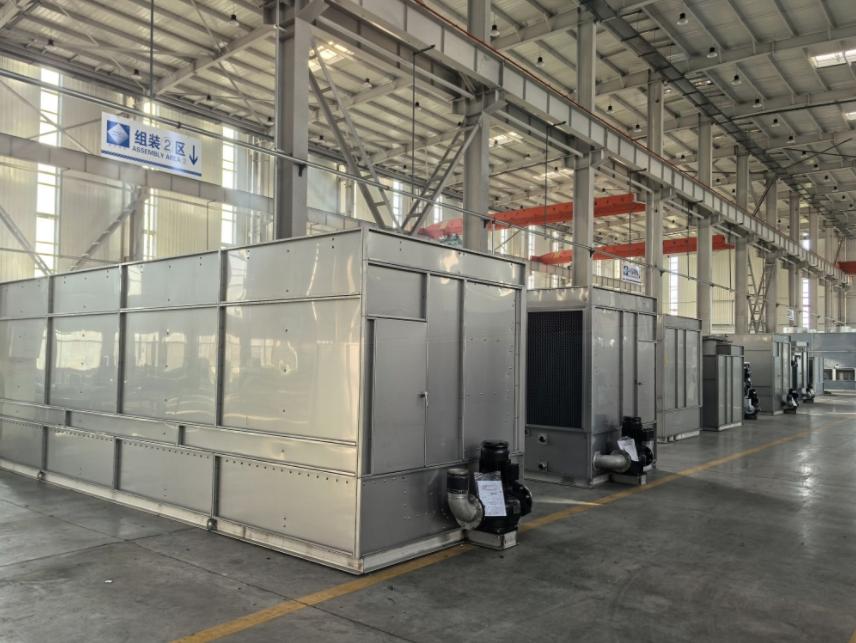
A crossflow cooling tower creates horizontal airflow through the fill while water travels downward.
This different arrangement can provide several practical advantages, especially when accessibility and maintenance are important.
One major advantage often associated with crossflow towers is accessibility.
The distribution basins and related components can be relatively easy to inspect and maintain.
This can be particularly useful in industrial plants where technicians regularly need to inspect the water-distribution system.
Crossflow towers can also be attractive for applications where operational flexibility is important.
For example, a facility may not operate at 100% production capacity throughout the entire year.
Cooling demand can rise and fall.
A well-designed cooling system should therefore be able to handle changing loads without unnecessary energy consumption.
Another consideration is water quality.
In some industrial applications, water may contain suspended solids, dust, scale, or other contaminants.
The cooling tower design, fill type, filtration system, and water-treatment program should all be evaluated together.
The main consideration with crossflow can be installation space.
Depending on the specific model and capacity, a crossflow tower may require a larger plan area than a comparable counterflow tower.
But don't make the mistake of comparing only the tower's basic dimensions.
You also need to consider:
Air inlet clearance
Maintenance access
Piping
Fan service area
Electrical equipment
Water-treatment equipment
Future replacement access
A tower that looks compact on a drawing isn't necessarily the most space-efficient solution once the entire installation is considered.
So how do the two designs compare?
| Factor | 400 Ton Counterflow | 400 Ton Crossflow |
|---|---|---|
| Air direction | Generally upward | Generally horizontal |
| Water direction | Downward | Downward |
| Air-water relationship | Opposite directions | Perpendicular directions |
| Footprint | Often compact | May require more plan area |
| Water distribution | Typically pressurized/nozzle based | Commonly gravity-fed basin |
| Maintenance | Depends on tower design | Often convenient around distribution areas |
| Water quality | Must match fill and distribution system | Must match fill and distribution system |
| Energy use | Depends on complete system | Depends on complete system |
| Winter operation | Project-specific | Project-specific |
| Best choice | Depends on project requirements | Depends on project requirements |
Notice something?
There isn't a column saying “winner.”
That's because there shouldn't be one.
A cooling tower isn't a smartphone where you can simply compare specifications and choose the model with the biggest number.
It's an engineered system.
If your site has limited space, counterflow deserves serious consideration.
A compact tower can simplify installation and leave more room for other plant equipment.
But footprint should always be evaluated together with service access.
A tower may fit physically into a small area but become difficult to maintain if there isn't enough space around it.
Ask your supplier for the complete installation footprint, not just the equipment dimensions.
That should include the space needed for:
Air intake
Service access
Piping
Electrical connections
Fan maintenance
Fill replacement
That's the number that actually matters.
Which is more energy efficient, counterflow or crossflow?
The honest answer is:
It depends.
Tower energy consumption depends on much more than tower configuration.
Consider:
Fan power
Pump power
Water flow
Airflow
Fill pressure drop
Fan efficiency
Motor efficiency
Operating hours
Variable-speed control
Two 400 ton towers can have different energy consumption even if they use the same basic configuration.
That's why you should compare the complete system rather than looking only at fan horsepower.
A cooling tower that saves a few kilowatts every hour can create meaningful savings over years of operation.
Here's a question buyers sometimes forget:
What happens five years after installation?
The tower may look fantastic when it arrives at the factory.
But cooling towers live in a wet, demanding environment.
Eventually, components need inspection, cleaning, adjustment, or replacement.
You should therefore evaluate access to:
Fill
Nozzles
Distribution basins
Fans
Motors
Gearboxes
Bearings
Drift eliminators
Cold-water basin
Crossflow towers are often attractive when easy access to water-distribution areas is important.
Counterflow towers can also provide good maintenance access if they are properly designed.
So don't make your decision based on configuration alone.
Ask the manufacturer to show you how technicians will actually maintain the tower.
Water quality can completely change the conversation.
Industrial cooling water may contain:
Suspended solids
Dust
Scale
Oil
Corrosion products
Biological growth
Process contaminants
These contaminants can accumulate in fill, nozzles, basins, and piping.
Film fill can provide excellent heat-transfer performance when water quality is suitable.
Splash fill may be considered for applications where fouling resistance and ease of cleaning are higher priorities.
The key is matching the fill to the water.
Don't select fill only because its catalog shows a high heat-transfer rate.
Ask:
Will this fill continue performing well after months or years of actual industrial operation?
That's a much better question.
If your facility operates in a cold climate, winter operation needs to be considered before you purchase the tower.
Potential problems include:
Ice formation
Reduced water flow
Low cooling load
Uneven water distribution
Fan control problems
Freeze-related damage
Counterflow and crossflow towers can have different winter operating characteristics.
The right solution depends on climate, tower design, load profile, water temperature, and control strategy.
If your cooling tower will operate year-round, tell the manufacturer about your winter conditions.
Don't treat winter operation as an afterthought.
The answer depends on the industrial process.
There is no single configuration that fits every plant.
Manufacturing plants often have variable cooling loads.
A factory may run several production lines during the day and fewer lines at night.
The cooling system therefore needs to handle changing demand.
When selecting a 400 ton cooling tower for manufacturing, consider:
Peak cooling load
Average cooling load
Minimum cooling load
Water-flow variation
Required cold-water temperature
Available installation space
If space is limited, counterflow may be attractive.
If maintenance accessibility is a major consideration, crossflow may deserve closer evaluation.
Steel and metal-processing applications can be particularly demanding.
Cooling water may be exposed to:
Dust
Scale
Oil
High temperatures
Suspended solids
Corrosion products
This makes water treatment and fill selection extremely important.
A tower designed for clean HVAC water may not be appropriate for a heavily contaminated industrial water loop.
For steel and metal-processing applications, evaluate:
Fill type
Water-treatment requirements
Basin design
Water-distribution system
Corrosion resistance
Maintenance access
Mechanical reliability
In other words, don't just ask which tower transfers heat more efficiently.
Ask which tower can continue doing the job under your actual plant conditions.
HVAC systems can have a different set of priorities.
Space, sound, energy consumption, appearance, seasonal operation, and maintenance can all influence the decision.
A compact counterflow cooling tower may be attractive when rooftop or mechanical-room space is limited.
A crossflow cooling tower may be attractive when easy access and maintenance are important.
Again, start with the application.
Then select the tower.
Instead of immediately asking “counterflow or crossflow?”, follow a logical selection process.
Start with the actual operating data.
You should know:
Hot-water temperature
Cold-water temperature
Water flow rate
Cooling range
Approach
A manufacturer cannot properly select a tower based only on the phrase “400 tons.”
Give the supplier the complete thermal requirements.
That allows the manufacturer to determine the appropriate tower size, fill, airflow, fan, and configuration.
Wet-bulb temperature is critical for evaporative cooling towers.
Why?
Because evaporation depends on atmospheric conditions.
A tower installed in a hot, humid climate faces different conditions from one installed in a cooler, drier region.
Therefore, your tower should be selected using the appropriate design wet-bulb temperature for the project location.
This parameter can have a major impact on tower performance.
Measure the complete installation area.
Don't measure only the foundation.
Consider:
Tower dimensions
Air inlet clearance
Maintenance space
Piping
Electrical equipment
Fan service area
Crane access
Future replacement access
This is especially important when comparing a 400 ton counterflow tower with a crossflow tower.
Water treatment should be discussed before tower selection.
Tell the manufacturer about:
Water hardness
Suspended solids
Oil contamination
Corrosion potential
Biological growth
Chemical treatment
Filtration
These factors may influence fill selection and the overall tower configuration.
The purchase price is only the beginning.
Your actual ownership cost can include:
Equipment + installation + electricity + water + chemicals + maintenance + replacement parts
A cheaper tower isn't automatically a cheaper tower to own.
If one design requires more energy every hour, those operating costs can eventually become much larger than the original price difference.
Fill is one of the most important components inside an evaporative cooling tower.
Its purpose is to increase the contact area between water and air.
Two common categories are:
Film fill spreads water into thin layers over a large surface area.
It can provide excellent heat-transfer performance when the circulating water is relatively clean and properly treated.
Splash fill repeatedly breaks falling water into droplets.
It may be preferred for certain applications where fouling, suspended solids, or cleaning requirements are major considerations.
For a 400 ton tower, fill selection should consider:
Water quality
Suspended solids
Operating temperature
Fouling potential
Required thermal performance
Cleaning frequency
Expected service life
The highest theoretical efficiency isn't always the best real-world choice.
Reliability matters too.
The fan is responsible for moving the air needed for evaporative heat rejection.
For a 400 ton cooling tower, fan selection can affect:
Airflow
Power consumption
Noise
Cooling performance
Operating reliability
Important factors include:
Fan diameter
Blade design
Motor efficiency
Rotation speed
Air volume
Static pressure
Fan-stack design
If the cooling load changes significantly throughout the year, variable-speed control may also be worth considering.
The goal isn't simply to move as much air as possible.
The goal is to move the right amount of air efficiently.
Even the best-designed cooling tower needs maintenance.
A practical maintenance program should include routine inspections of mechanical and water-side components.
Inspect:
Fan operation
Water distribution
Basin condition
Water quality
Vibration
Unusual noise
Inspect:
Fill
Drift eliminators
Nozzles
Motors
Gearboxes
Bearings
Structural components
A more detailed inspection should look for:
Corrosion
Cracks
Fill deterioration
Scaling
Biological growth
Mechanical wear
Water-distribution problems
The principle is simple:
Fix small problems before they become production problems.

Mach Industry (Zhejiang) Co.,Ltd is a professional cooling tower manufacturer serving industrial and commercial cooling applications.
According to Mach's current official website, its product range includes industrial cooling towers, closed cooling towers, and open cooling towers, with both counterflow and crossflow configurations. Mach states that its cooling tower capacity ranges from 3 tons to 5,000 tons per cell, with multi-cell solutions available.
For a 400 ton cooling tower project, this means buyers can discuss the actual application and operating conditions with a manufacturer that offers multiple cooling tower configurations.
Mach's website states that its cooling towers are used in industries including central air-conditioning, sugar, power plants, petroleum, smelting, printing and dyeing, and other applications.
Its current product range includes:
Industrial counterflow cooling towers
Industrial crossflow cooling towers
Closed counterflow cooling towers
Closed crossflow cooling towers
Mixed-flow closed cooling towers
Open counterflow cooling towers
Open crossflow cooling towers
Mach also describes its factory as being located in Dongguan Industrial Zone in Shaoxing, Zhejiang, with a factory area of approximately 9,000 square meters. Its website displays certifications and qualifications including CE, CTI, Bureau Veritas, ISO 9001, and SGS.
For a 400 ton project, buyers should provide the manufacturer with the required heat load, water flow, entering and leaving water temperatures, design wet-bulb temperature, water quality, installation space, and operating requirements.
That information allows the supplier to evaluate whether a counterflow or crossflow configuration is more appropriate.
Before ordering a 400 ton cooling tower, ask your manufacturer these questions:
1. Is the quoted 400 tons based on my actual design conditions?
Don't assume that every 400 ton tower is designed for exactly the same conditions.
2. What water flow rate is required?
Water flow directly affects the tower's thermal selection.
3. What are the entering and leaving water temperatures?
These temperatures define an important part of the cooling requirement.
4. What design wet-bulb temperature is being used?
The answer should match your actual project conditions.
5. Should I choose counterflow or crossflow?
Ask the supplier to explain the recommendation based on your site rather than simply promoting one configuration.
6. What fill type is appropriate for my water quality?
Film fill and splash fill have different characteristics and should be matched to the application.
7. What are the expected energy and maintenance costs?
Don't focus only on the initial quotation. Ask about long-term operation.
So, 400 ton counterflow cooling tower vs crossflow — which should you choose?
The answer isn't simply “counterflow” or “crossflow.”
Think of it like choosing between two roads.
One road may be shorter.
Another may be easier to maintain.
But which one is right depends on where you're going.
Choose a 400 ton counterflow cooling tower when factors such as compact footprint, site limitations, and the specific thermal design make that configuration suitable.
Consider a 400 ton crossflow cooling tower when accessibility, water-distribution design, maintenance considerations, or particular operating conditions make that configuration more suitable.
For either option, the final selection should be based on:
Cooling load
Water flow
Temperature range
Wet-bulb temperature
Water quality
Available footprint
Energy consumption
Maintenance requirements
Climate
Total lifecycle cost
That's the smarter way to choose a 400 ton cooling tower.
Don't ask only:
“Which cooling tower is better?”
Ask:
“Which cooling tower is better for my application?”
That change in perspective can make the entire purchasing process easier.
With the right engineering data and a qualified manufacturer such as Mach Industry (Zhejiang) Co.,Ltd, buyers can compare counterflow and crossflow configurations based on actual project requirements instead of relying on a generic “better or worse” comparison.
The best cooling tower isn't necessarily the one with the most impressive specification sheet. It's the one that keeps your process cool, efficient, maintainable, and reliable for years to come.