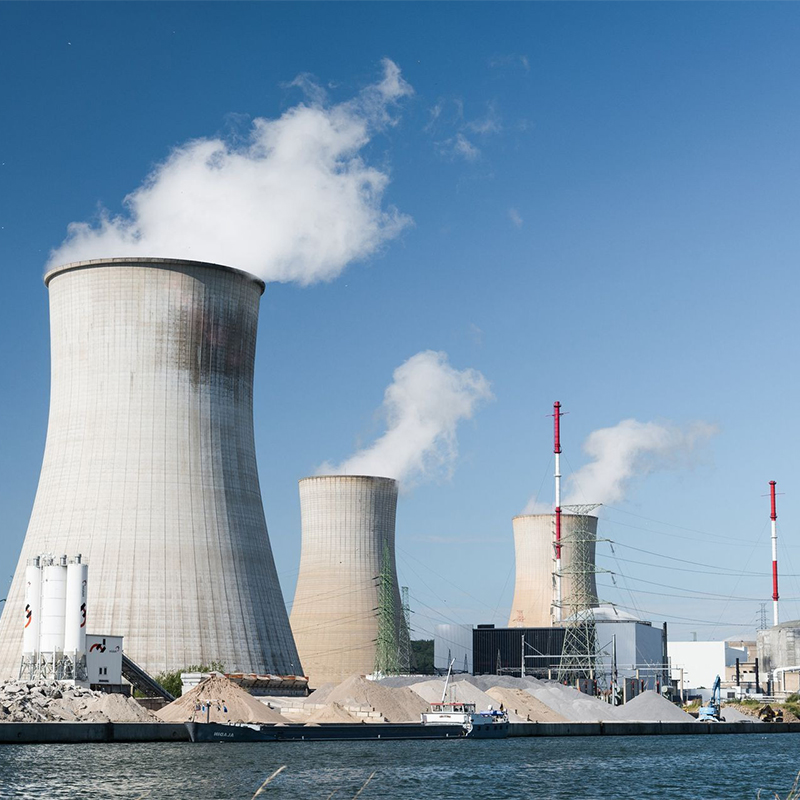
We Provide Cooling Tower Solution

Views: 0 Author: Site Editor Publish Time: 2025-11-26 Origin: Site


A water cooling tower is a widely used heat-rejection device in industrial systems and HVAC (heating, ventilation, and air-conditioning) applications. By allowing hot circulating water to contact ambient air, the tower removes heat through evaporation and convection, lowering the water temperature and enabling it to be reused in the system.
Cooling towers are essential in power plants, manufacturing facilities, central air-conditioning systems, petrochemical plants, and many other sectors. This article explains the basic structure, working principles, heat-exchange mechanisms, advantages, and classifications of water cooling towers, with insights from the manufacturer MachCooling (https://www.machcooling.com/).
A typical water cooling tower includes the following major parts:
The structural enclosure, commonly made of FRP, stainless steel, or corrosion-resistant materials.
Pipes and spray nozzles that distribute incoming hot water evenly onto the fill.
A set of plastic film sheets, grid structures, or corrugated layers that maximize the surface area for heat transfer between air and water.
For mechanical draft towers, fans actively draw or push air through the tower. Natural-draft towers rely on chimney effect airflow.
Reduces water droplets carried away by exhaust air, minimizing water loss and environmental impact.
Collects cooled water at the bottom for recirculation.

The cooling tower removes heat primarily through air–water contact and evaporative cooling. The overall working process includes the following steps:
Heated water from equipment (such as condensers, industrial machines, or HVAC systems) is pumped to the top of the cooling tower.
The distribution system sprays the water evenly onto the fill, forming thin water films or droplets.
Air enters from the tower’s intake openings (either forced by fans or naturally induced). As air flows across the descending hot water, the two streams meet in a counterflow or crossflow configuration.
At the fill pack, air absorbs heat and causes part of the water to evaporate.
Heat removal occurs in two main ways:
Sensible Heat Transfer
Temperature difference between water and air directly causes heat exchange.
Latent Heat Transfer (Evaporation)
A small portion of water evaporates.
Since evaporation requires large amounts of latent heat, it absorbs heat from the remaining water and significantly reduces its temperature.
Evaporative cooling contributes the majority of the cooling effect.
After heat exchange, the cooled water drops into the cold-water basin at the bottom and is pumped back into the system.
Warm, moisture-laden exhaust air exits from the top of the tower.
The fill pack is essential for efficient cooling. It increases the contact surface between water and air, allowing more evaporation and better heat exchange.
Its functions include:
Spreading water evenly
Extending water residence time
Creating turbulent air–water interaction
| Heat-Transfer Type | Description | Typical Share |
|---|---|---|
| Sensible heat | Direct heat exchange due to temperature difference | 15–25% |
| Latent heat (evaporation) | Water evaporation absorbs large latent heat | 70–80% |
| Radiation | Minimal, usually negligible | <5% |
The high contribution of latent heat transfer explains why cooling towers are so efficient.
Mechanical Draft Cooling Towers
Fans actively move air through the tower. Suitable for medium to large-scale applications requiring high cooling performance.
Natural Draft Cooling Towers
Utilize chimney effect and density differences between hot and cold air. Common in large power-plant cooling towers.
Open-Circuit Cooling Tower (Open Cooling Tower)
Circulating water directly contacts air. Most common type.
Closed-Circuit Cooling Tower (Closed Cooling Tower)
Process fluid flows inside coils; spray water cools the coils.
Suitable when water quality control is critical.
Water cooling towers are widely used in:
Industrial process cooling (chemical, metallurgy, plastics, injection molding, etc.)
Chiller and HVAC systems in large buildings
Power-plant condenser cooling systems
Refrigeration and thermal-processing systems
As a dedicated manufacturer, MachCooling provides extensive cooling-tower solutions and maintenance practices. Their operational guidelines emphasize:
For open-circuit towers:
Clean biological deposits and sediments regularly
Perform disinfection and algae control every quarter
Keep basin strainers clean (recommended mesh ≤ 2 mm)
For closed-circuit towers:
Inspect coil tubes for scaling
Use eddy-current tests to check tube thickness
Flush or replace corroded pipes when needed
For all tower types:
Ensure uniform water distribution
Replace aged or clogged fill
Maintain proper fan operation and airflow balance
These measures improve cooling efficiency and extend equipment life while reducing operational costs.
A water cooling tower is an essential and highly efficient heat-rejection device used across numerous industries and HVAC systems.
By leveraging evaporative cooling and air–water heat exchange, cooling towers significantly lower the temperature of circulating water and ensure stable operation of industrial and mechanical systems.
Selecting the right type of cooling tower—open or closed, mechanical or natural draft—combined with proper maintenance and water-quality control, guarantees long-term reliability and performance.
MachCooling provides professional cooling-tower systems and technical guidance, offering users dependable and sustainable cooling solutions.