We Provide Cooling Tower Solution

Views: 0 Author: Cindy Publish Time: 2026-09-07 Origin: Site


China has become an important manufacturing and sourcing market for cooling towers, serving industrial facilities, commercial buildings, HVAC systems, data centers, power plants, chemical plants, and process-cooling applications around the world.
But here is the problem: How do you know which cooling tower manufacturer is actually worth considering?
Search online and you will find hundreds of suppliers. Some focus on low-cost standard towers. Others specialize in large industrial projects. Some manufacture open cooling towers, while others focus on closed-circuit systems, evaporative fluid coolers, or complete heat-rejection solutions.
This guide reviews the top 7 cooling tower manufacturers in China and international brands serving the Chinese and global market. The list places MACH Industry (Zhejiang) Co., Ltd. first as the featured Chinese manufacturer, followed by six established international cooling technology brands.
The goal is not simply to create another manufacturer list. Instead, we will look at what each company offers, which applications they serve, what type of cooling tower they are known for, and what buyers should consider before making a final decision.
China has one of the world's largest manufacturing ecosystems, which naturally supports a strong supply chain for thermal-management equipment.
A cooling tower requires much more than a fiberglass shell and a fan. The complete system can include heat-transfer fill, water distribution systems, spray nozzles, fans, motors, gearboxes, drift eliminators, structural components, electrical controls, pumps, and water-treatment equipment.
Having access to a mature manufacturing supply chain allows Chinese cooling tower manufacturers to provide both standard products and customized solutions.
For international buyers, this can create several advantages:
Competitive manufacturing costs
Flexible product customization
Large production capacity
Wide component availability
OEM and project-based manufacturing
International export experience
A broad selection of cooling tower designs
At the same time, buyers should not assume that every Chinese supplier offers the same engineering quality. A cooling tower is a performance-critical component, so manufacturer selection matters.
Choosing a cooling tower manufacturer is not simply a matter of comparing quotations.
Imagine buying a truck by looking only at its price. You would still need to know its engine capacity, fuel consumption, payload, reliability, maintenance requirements, and intended application.
Cooling towers work in much the same way.
A reliable supplier should understand different tower configurations and be able to recommend equipment according to actual operating conditions.
Important parameters include:
Heat load
Water flow rate
Hot-water temperature
Cold-water temperature
Design wet-bulb temperature
Approach temperature
Ambient conditions
Installation height
Available footprint
Noise requirements
Water quality
A manufacturer that understands these variables can help prevent the most expensive mistake in cooling-tower purchasing: selecting equipment that looks right on paper but cannot achieve the required thermal performance in the field.
Buyers should also examine manufacturing quality.
Depending on the project, useful documentation may include ISO certification, CE documentation, CTI-related performance certification, material specifications, factory test records, technical drawings, and quality-control procedures.
Certifications are valuable, but they should not be the only consideration. Ask for technical documentation and project references as well.
A cooling tower is a long-term investment.
Even a well-designed system eventually requires inspection, cleaning, water-treatment management, mechanical checks, component replacement, and performance monitoring.
That is why cooling tower maintenance and after-sales support should be evaluated before purchase rather than after installation.
The following manufacturers represent a combination of one specialized Chinese supplier and six established international cooling technology brands.
The ranking is an editorial comparison based on market presence, product range, engineering capabilities, brand recognition, and relevance to industrial and commercial cooling applications. It should not be interpreted as an official industry ranking.
MACH Industry (Zhejiang) Co., Ltd. is the featured Chinese cooling tower manufacturer in this list.
MACH specializes in cooling tower equipment and related solutions for industrial and commercial applications. Its official product portfolio includes industrial cooling towers, closed cooling towers, and open cooling towers, with both counterflow and crossflow configurations.
The company is based in Zhejiang, China, and focuses on providing cooling equipment for customers that need application-specific thermal performance rather than simply an off-the-shelf product.
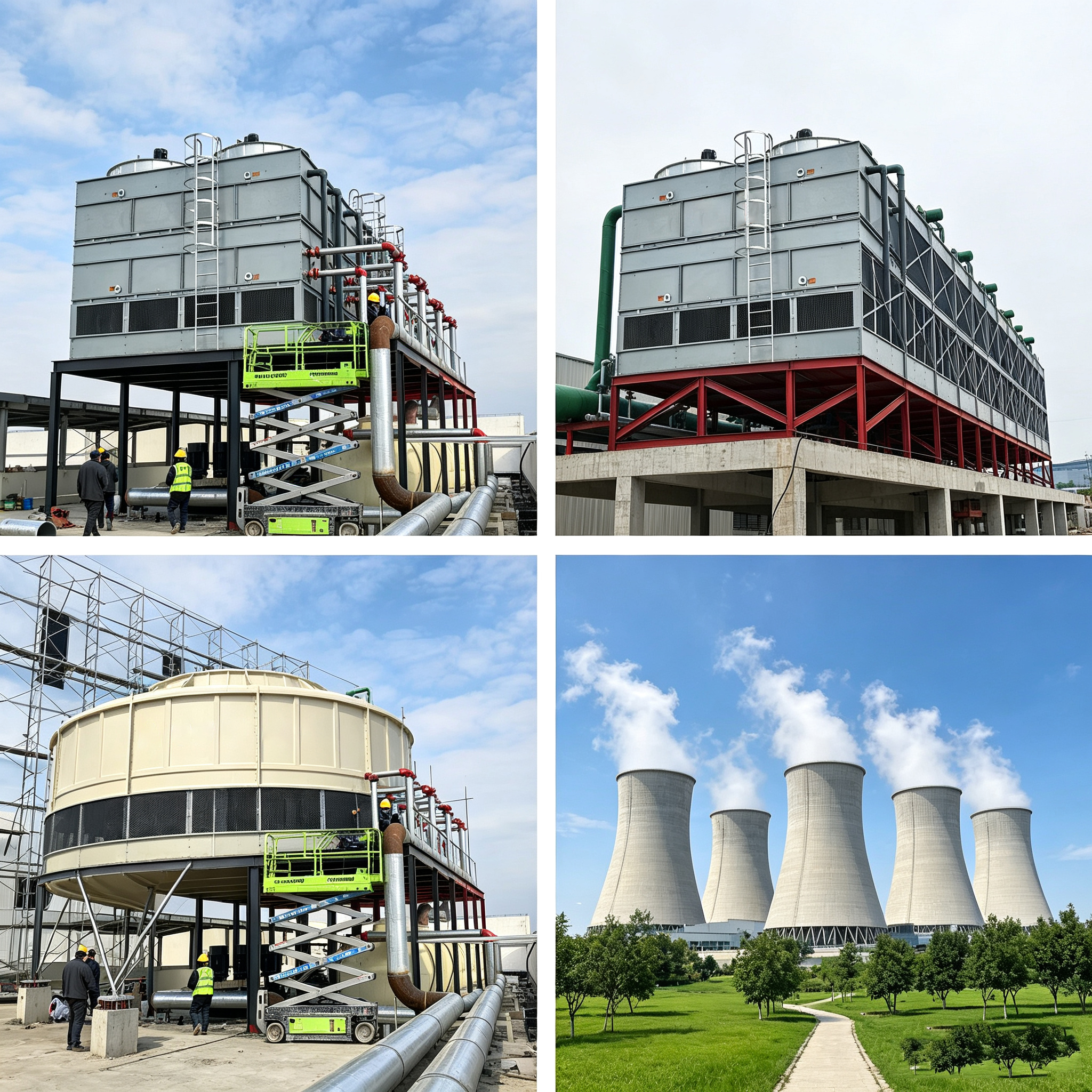
MACH offers several major cooling tower configurations, including:
Counter Flow Industrial Cooling Tower
Cross Flow Industrial Cooling Tower
Counter Flow Closed Cooling Tower
Cross Flow Closed Cooling Tower
Mixed Flow Closed Cooling Tower
Counter Flow Cooling Tower
Cross Flow Cooling Tower
This product range allows MACH to serve a variety of applications, from conventional HVAC systems to demanding industrial process cooling.
The company also highlights certifications and quality-management credentials on its website, including CE, ISO 9001, SGS, Bureau Veritas, and CTI-related documentation.
One of MACH's key advantages is flexibility.
Not every cooling application fits neatly into a standard catalog model. An injection-molding plant, for example, may have completely different cooling requirements from a commercial office building.
MACH can therefore be considered when buyers need:
Customized cooling capacity
Industrial cooling towers
Crossflow cooling towers
Counterflow cooling towers
Closed-circuit systems
FRP cooling towers
Cooling tower spare parts
Technical support for system selection
For buyers comparing cooling tower manufacturers, MACH is particularly relevant when cost competitiveness, customization, and direct communication with the manufacturer are important.
Official website: MACH Industry (Zhejiang) Co., Ltd.

Baltimore Aircoil Company (BAC) is one of the best-known international companies in evaporative cooling and heat rejection.
BAC provides cooling towers for condenser-water and industrial-process applications. Its portfolio includes crossflow and counterflow cooling towers, as well as closed-circuit cooling products and other evaporative heat-transfer equipment.
One notable aspect of BAC's portfolio is the range of tower configurations available for different space and performance requirements.
For example, its Series 3000 and Series 1500 products use crossflow configurations, while the PT2 uses counterflow technology. BAC also offers industrial-grade modular cooling tower options designed for demanding water conditions.
BAC is therefore a strong reference point for buyers evaluating:
Commercial HVAC
Industrial process cooling
Data center cooling
Water-cooled systems
Closed-circuit cooling
High-efficiency heat rejection
The company's long history and international service network also make it a major competitor to consider when comparing a Chinese supplier with a global brand.

SPX Cooling Technologies is another major international name in the cooling tower industry, particularly through its Marley brand.
SPX states that its cooling technology businesses have roots going back more than 100 years and serve HVAC, process cooling, industrial, refrigeration, and other markets. The company has more than 150 offices, subsidiaries, and partners worldwide.
Its cooling tower portfolio includes crossflow, counterflow, forced-draft, natural-draft, modular, and field-erected designs.
For large industrial facilities, SPX Marley offers field-erected cooling towers engineered for applications such as power generation, oil and chemical refining, and heavy manufacturing. These towers are available in both crossflow and counterflow configurations.
SPX is particularly relevant for projects where engineering design, large heat loads, long-term service, and established technology are major priorities.
EVAPCO is a global manufacturer specializing in heat-transfer and evaporative-cooling technology.
The company serves several major markets, including commercial HVAC, industrial process cooling, data centers, industrial refrigeration, and power generation.
EVAPCO's product portfolio includes factory-assembled cooling towers, closed-circuit coolers, evaporative condensers, hybrid cooling equipment, dry cooling equipment, water-treatment systems, and related technologies.
One interesting aspect of EVAPCO's approach is its focus on different cooling technologies rather than relying exclusively on conventional evaporative cooling.
The company offers evaporative, hybrid, dry, and adiabatic technologies, giving engineers more options when water consumption, energy efficiency, or environmental conditions become important design considerations.
EVAPCO is therefore worth considering for sophisticated cooling tower systems, particularly in data centers, industrial facilities, HVAC plants, and other applications where energy and water efficiency matter.
HAMON is an international engineering company with a long history in heat-transfer and cooling technologies.
Its cooling solutions are particularly associated with large industrial applications, power generation, process industries, and major infrastructure projects.
HAMON's position in the market is somewhat different from a manufacturer focused primarily on small packaged HVAC towers. Its engineering orientation makes it more relevant when a project involves significant heat loads, complex site conditions, or large-scale cooling infrastructure.
For buyers evaluating international cooling tower manufacturers, HAMON can therefore be considered when the project requires engineering-intensive solutions rather than a simple standardized tower.
Typical applications can include:
Power generation
Industrial processing
Petrochemical facilities
Large-scale manufacturing
District energy
Heavy industry
This makes HAMON a useful benchmark when comparing a customized Chinese industrial cooling tower with a large international engineering solution.
Paharpur Cooling Towers is an established international cooling technology company headquartered in India.
The company is known for industrial cooling towers and large-scale heat-rejection solutions and has served power generation and industrial applications for decades.
Paharpur is particularly relevant in markets where large industrial cooling systems are required.
Its experience demonstrates an important point for buyers: cooling tower selection should be based on thermal performance and project requirements, not simply geographic location or brand popularity.
For a large power or industrial project, buyers should compare the proposed cooling tower designs from several manufacturers using identical design conditions.
That makes the comparison much more meaningful than simply comparing catalog prices.
ENEXIO is a global engineering and technology company associated with cooling and heat-transfer solutions, particularly for energy and industrial applications.
Its expertise is especially relevant to large-scale cooling infrastructure and power-generation projects.
Compared with a standard commercial HVAC cooling tower supplier, an engineering-focused company such as ENEXIO is more likely to become involved in complex project requirements where cooling performance, environmental conditions, water consumption, and system integration all need to be considered together.
For international EPC contractors and industrial operators, this type of engineering capability can be especially valuable.
Not all cooling towers work in the same way.
Before selecting a supplier, you should understand the major configurations.
A cross flow cooling tower allows air to travel horizontally across the falling water.
The design is popular because the water-distribution system can be relatively accessible for inspection and maintenance.
Crossflow towers are commonly used in HVAC and industrial applications.
Their practical advantages can include:
Easy access to distribution areas
Convenient inspection
Straightforward maintenance
Flexible installation options
Good suitability for commercial HVAC applications
However, the best choice still depends on the required thermal performance and site conditions.

A counterflow cooling tower moves air upward while water travels downward through the heat-transfer fill.
Think of it as two streams moving in opposite directions.
This arrangement can provide effective heat transfer within a relatively compact footprint and is widely used in industrial and commercial cooling applications.
MACH, BAC, SPX Marley, and EVAPCO all have product families or technologies covering counterflow configurations.

A closed loop cooling tower, also called a closed-circuit cooling tower, separates the process fluid from direct contact with the outside air.
Instead of sending the process fluid directly over the tower fill, the fluid travels through a heat-transfer coil.
This arrangement can be useful when maintaining process-fluid quality is important.
Typical applications include:
Process cooling
Machinery cooling
Data centers
Heat exchangers
Industrial manufacturing
Specialized HVAC systems
Closed-loop systems can also help reduce contamination risks and make certain process-cooling applications easier to control.
An industrial cooling tower is designed for process applications where heat loads and operating conditions can be more demanding than those found in ordinary commercial buildings.
Industrial applications may include:
Plastic injection molding
Steel production
Chemical processing
Power generation
Food processing
Pharmaceutical manufacturing
Petroleum refining
Manufacturing plants
The tower may need to operate continuously, handle challenging water conditions, and maintain stable thermal performance under changing loads.
That is why industrial towers often require more detailed engineering than standard HVAC equipment.
An HVAC cooling tower is typically part of a water-cooled chiller system.
The tower removes heat from condenser water and rejects that heat into the atmosphere.
In a commercial building, the process generally looks like this:
Building → Chilled Water System → Chiller → Condenser Water → Cooling Tower → Atmosphere
The cooling tower and chiller therefore work as a team.
If the tower is undersized, the chiller may operate under less favorable conditions. If the tower is significantly oversized, the project may incur unnecessary capital costs.
The goal is balance.
A water cooling tower works primarily through evaporative heat transfer.
Hot water enters the tower and is distributed over the heat-transfer fill. Air moves through the tower, and a small portion of the circulating water evaporates.
That evaporation removes heat from the remaining water.
The cooled water collects in the basin and returns to the system.
It sounds simple, but the engineering behind that simple principle can become quite sophisticated.
Fan selection, fill design, water distribution, airflow, wet-bulb temperature, approach temperature, and water chemistry all affect actual performance.
BAC describes the same basic principle: hot process or condenser water is distributed over the heat-transfer surface while air passes through the tower, with evaporation removing heat from the remaining water.
A cooling tower is only one part of a larger system.
A complete cooling tower system may include:
Cooling tower
Chiller
Condenser-water pumps
Process pumps
Piping
Valves
Water-treatment equipment
Fans
Motors
Electrical controls
Sensors
Automation systems
This is why selecting a cooling tower based only on tons of cooling can be misleading.
For a chiller cooling tower, the design should be coordinated with the chiller's condenser-water requirements.
For an industrial application, the tower should instead be matched to the process heat load and operating conditions.
The system should be designed as a complete chain rather than as a collection of unrelated components.
Even the best cooling tower needs maintenance.
Dust, scale, biological growth, corrosion, debris, and mechanical wear can gradually reduce performance.
A good cooling tower maintenance program should normally consider:
Check spray nozzles, distribution pipes, basins, and flow balance.
Inspect the fill for scaling, biological growth, blockage, deformation, or damage.
Inspect fan blades, bearings, shafts, motors, belts, gearboxes, and vibration.
Damaged or blocked drift eliminators can reduce performance and increase water carryover.
Water chemistry is critical.
Poor water treatment can result in scaling, corrosion, fouling, and microbiological growth.
FRP, galvanized steel, stainless steel, fasteners, supports, and other components should be inspected according to the tower's operating environment.
A manufacturer that provides replacement parts and technical assistance can make long-term ownership considerably easier.
Buying the equipment is only the beginning.
Professional cooling tower services can include:
Equipment inspection
Thermal performance evaluation
Cleaning
Fill replacement
Fan maintenance
Motor inspection
Gearbox service
Spray-nozzle replacement
Drift-eliminator replacement
Water-distribution inspection
Tower refurbishment
System upgrades
This is particularly important for industrial facilities where unexpected cooling-system downtime can interrupt production.
A cheap tower that becomes difficult to maintain can ultimately cost more than a higher-quality system with strong technical support.
So, what should you really look for?
A good cooling tower manufacturer should ideally provide more than a product catalog.
Look for these qualities:
1. Engineering capability
The supplier should understand your operating conditions and calculate the required thermal performance.
2. Product variety
A broad range of crossflow, counterflow, open, and closed-circuit options provides greater flexibility.
3. Manufacturing quality
The tower should be built from appropriate materials and components for the operating environment.
4. Energy efficiency
Fan and pump energy consumption can have a major impact on lifecycle costs.
5. Maintenance support
Replacement parts and technical support should remain available after installation.
6. International experience
For export projects, experience with documentation, shipping, installation, and international standards can reduce project risk.
7. Customization
Industrial projects rarely fit perfectly into a single standard model.
This is where specialized manufacturers such as MACH can offer an interesting alternative to much larger international brands.
There is no universal winner.
A global brand such as BAC, SPX Marley, or EVAPCO may be attractive when a project requires extensive international engineering resources, established global service networks, or a particular proprietary technology.
On the other hand, a specialized Chinese manufacturer such as MACH may be attractive when the buyer places greater emphasis on customization, competitive manufacturing costs, direct communication, and flexible project requirements.
The best approach is to compare suppliers using the same technical specification.
For example:
| Evaluation Factor | MACH | International Brands |
|---|---|---|
| Chinese manufacturing | Strong | Varies |
| Customization | Strong | Strong |
| Industrial applications | Yes | Yes |
| Crossflow towers | Yes | Yes |
| Counterflow towers | Yes | Yes |
| Closed cooling towers | Yes | Yes |
| HVAC applications | Yes | Yes |
| Global brand recognition | Growing | Very strong |
| Cost competitiveness | Strong | Varies |
| Large international engineering network | Developing | Strong |
The table should be treated as a general purchasing framework rather than an absolute performance ranking.
The global cooling tower market gives buyers more choices than ever.
For companies sourcing from China, MACH Industry (Zhejiang) Co., Ltd. is a manufacturer worth including in the shortlist, particularly for industrial, open, crossflow, counterflow, and closed cooling tower applications.
International brands such as BAC, SPX Cooling Technologies/Marley, EVAPCO, HAMON, Paharpur Cooling Towers, and ENEXIO provide additional benchmarks for buyers evaluating large-scale engineering capabilities and global cooling technologies.
But remember one important point:
The best cooling tower manufacturer is not necessarily the company with the biggest name or the lowest price.
The right supplier is the one that can provide the appropriate thermal performance, construction materials, energy efficiency, reliability, maintenance support, and total lifecycle value for your application.
Before requesting a quotation, prepare your cooling-water flow rate, inlet temperature, outlet temperature, design wet-bulb temperature, heat load, installation conditions, water quality, and required materials.
Give the same specification to several manufacturers.
Then compare the engineering proposals—not just the prices.
That is how you turn a cooling tower purchase from a simple equipment transaction into a reliable long-term cooling solution.
There is no single manufacturer that is best for every application. For buyers looking for a Chinese supplier, MACH Industry (Zhejiang) Co., Ltd. is a strong option to evaluate for industrial, open, crossflow, counterflow, and closed cooling tower applications. International brands such as BAC, SPX Marley, and EVAPCO are also important benchmarks for larger or highly engineered projects.
For HVAC applications, the appropriate tower depends on the chiller capacity, condenser-water flow, design wet-bulb temperature, approach, noise requirements, and available space. Both crossflow and counterflow cooling towers can be suitable for HVAC applications when correctly designed.
A closed loop cooling tower uses a heat-transfer coil to keep the process fluid separated from direct contact with the cooling air and spray water. It is useful when maintaining process-fluid cleanliness or reducing contamination is important.
The exact maintenance schedule depends on operating conditions, water quality, tower design, environmental exposure, and operating hours. Regular inspection and water-quality management should be combined with periodic cleaning and mechanical inspection.
A cross flow cooling tower moves air horizontally across falling water, while a counterflow tower moves air upward against downward-flowing water. Crossflow designs can offer convenient maintenance access, while counterflow designs can provide efficient heat transfer within a compact footprint.
Yes. Many Chinese manufacturers provide customized cooling towers based on heat load, water flow, temperature range, materials, dimensions, fan selection, noise requirements, and installation conditions. The level of customization varies between manufacturers, so buyers should request engineering drawings and technical proposals before placing an order.
At minimum, provide the required cooling capacity or heat load, circulating-water flow rate, hot-water temperature, cold-water temperature, design wet-bulb temperature, installation location, available footprint, material requirements, power supply, and any noise or environmental restrictions.
The more complete the information, the more accurate the cooling tower selection and quotation will be.