We Provide Cooling Tower Solution

Views: 0 Author: Cindy Publish Time: 2026-10-10 Origin: Site


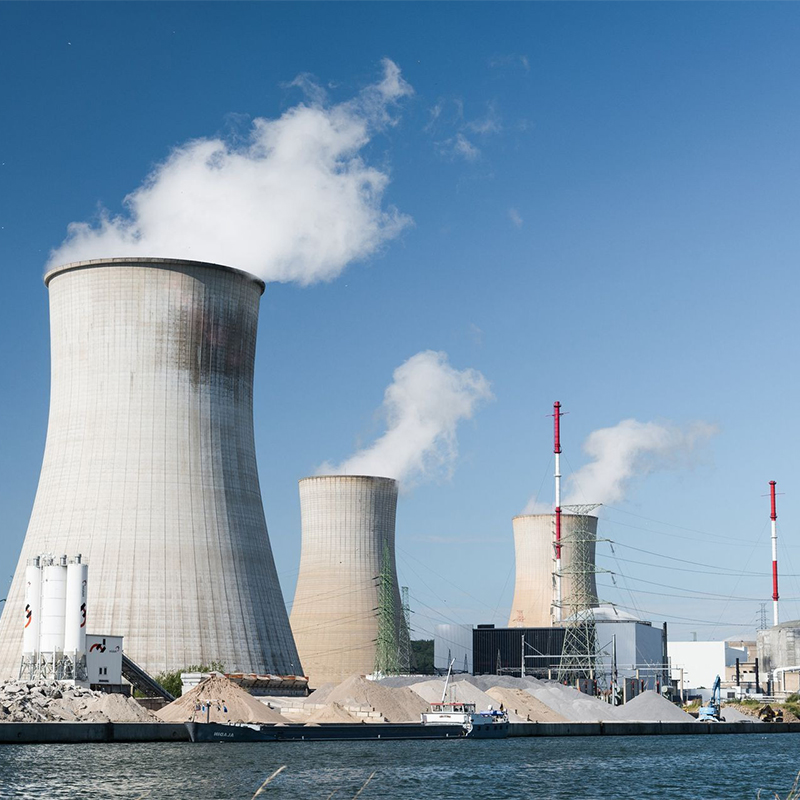
When people search for the largest cooling tower in the world, they usually imagine an enormous concrete structure rising hundreds of feet above a power plant.
And honestly, that image is not far from reality.
Some industrial cooling towers are so large that a person standing at their base looks tiny. Their curved concrete shells can dominate the skyline of a power station, while inside, millions of gallons of water may circulate through the cooling system.
But here is the interesting part: what exactly makes a cooling tower the “largest”?
Is it the tallest tower? The widest tower? The one handling the most water? Or the tower rejecting the greatest amount of heat?
There is no single universal answer because cooling tower size can be measured in several different ways. Natural-draft hyperbolic towers can reach roughly 200 meters in height and can handle extremely large water flows, making them particularly suitable for utility-scale power generation.
In this guide, we will look at the largest cooling tower in the world from an engineering perspective, including its types, design, capacity, components, industrial applications and maintenance requirements.
We will also explain how modern manufacturers such as Mach Industry (Zhejiang) Co.,Ltd support large-scale cooling tower projects and replacement-component requirements.
There is no universally accepted single answer to the question “What is the largest cooling tower in the world?”
Why?
Because cooling tower projects are measured differently.
One tower might be the tallest. Another might have a larger diameter. A third might circulate more cooling water. Another might have a higher total heat-rejection capacity.
For example, natural-draft cooling towers can exceed 400 feet in height and handle hundreds of thousands of gallons of water per minute. These towers are generally associated with very large utility and industrial facilities.
So when discussing the largest cooling tower, it is more accurate to talk about mega-scale cooling towers rather than declaring one structure the winner under every measurement.
Most of these giant towers are hyperbolic natural-draft structures.
Their shape is instantly recognizable: wide at the bottom, narrow around the middle and wider again toward the top.
It looks unusual, but the shape is highly practical.
The simple answer is heat.
Large power plants and industrial facilities generate enormous amounts of waste heat.
A steam turbine, for example, needs a condenser to convert exhaust steam back into water. That condenser releases heat into a cooling-water system. The cooling tower then rejects that heat to the atmosphere.
The bigger the thermal load, the more cooling water and airflow the system may require.
Think of it like a human body.
A small person does not need the same cooling capacity as a large industrial furnace. The cooling tower is essentially the industrial system's “heat-release organ.”
The bigger the heat source, the larger the heat-rejection system may need to become.
This is why giant cooling towers are commonly associated with power generation and other large continuous industrial processes. Natural-draft hyperbolic towers are particularly suited to very large water flows and utility-scale cooling duties.

Despite their enormous size, the basic principle of a giant cooling tower is surprisingly simple.
Hot water enters the cooling tower.
The water is distributed over a large cooling area and comes into contact with air.
A portion of the water evaporates.
That evaporation removes heat.
The cooled water collects at the bottom and returns to the plant.
The warm, moisture-rich air leaves through the top.
In a natural-draft tower, there is no need for a giant fan to pull the air upward. Instead, the tower uses the difference in density between cooler outside air and warmer, humid air inside the tower.
Warm air rises.
As it rises, it creates a pressure difference that draws cooler air into the lower part of the tower.
That is the chimney effect, or natural draft.
It is an elegant piece of engineering.
No enormous fan motor is required to create the main airflow.
Large cooling towers are not all built the same way.
Engineers classify them according to airflow, water flow, draft method and heat-transfer arrangement.
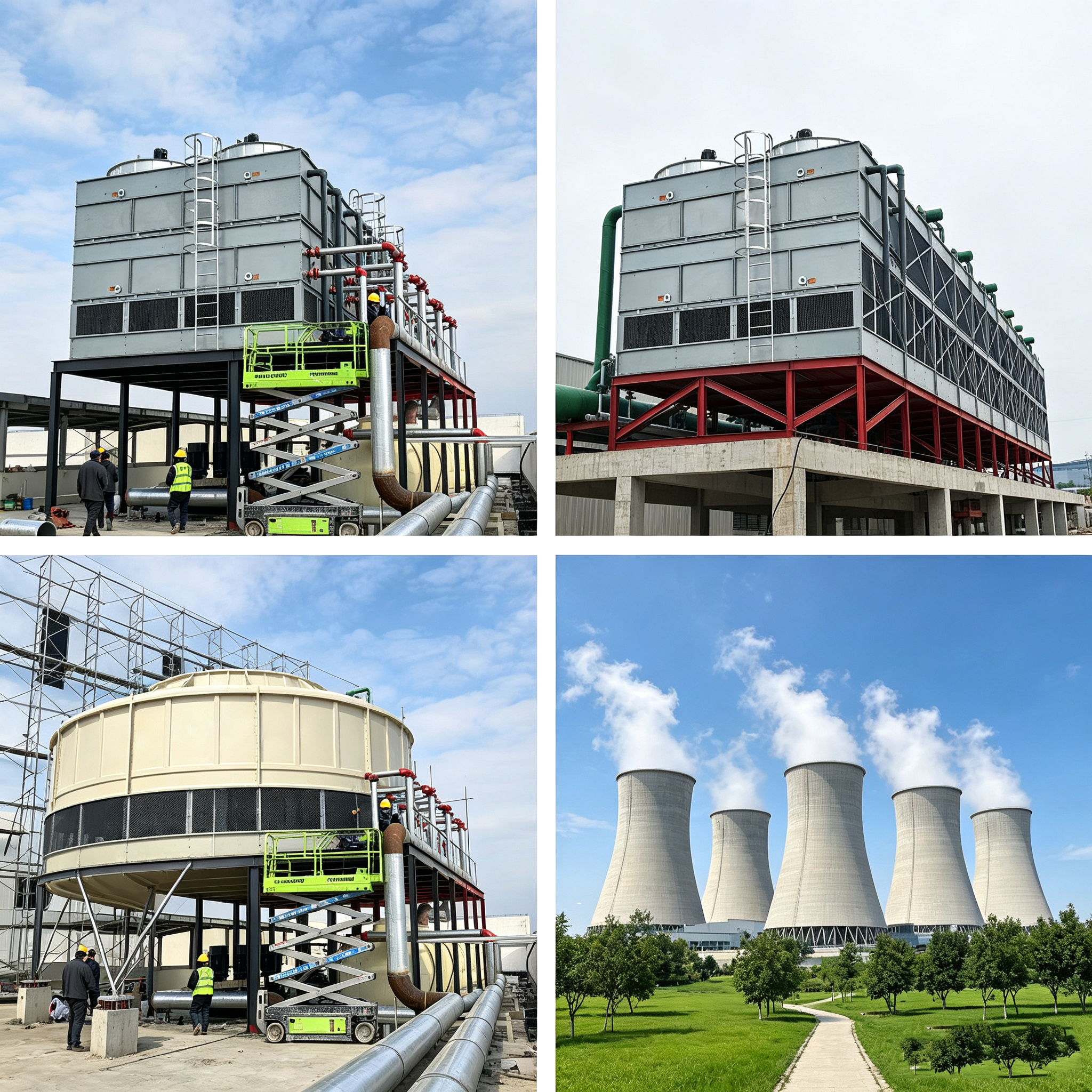
The natural-draft hyperbolic tower is the classic giant cooling tower.
Its reinforced-concrete shell creates a chimney effect that moves air naturally.
The hyperbolic form also provides structural strength while using material efficiently. The shape has become the standard configuration for many large natural-draft towers.
These towers are particularly common in large power-generation applications.
Their biggest advantage is scale.
When a plant needs to reject an enormous quantity of heat continuously, natural draft can provide huge airflow without the electrical demand associated with massive mechanical fans.
Mechanical-draft towers use fans to move air.
They can be divided into two major configurations:
Forced draft
Induced draft
In a forced-draft system, fans push air into the tower.
In an induced-draft system, fans pull air through the tower and discharge it from the top.
Mechanical draft gives operators greater control over airflow and can be used across a much wider range of capacities.
For many industrial plants, this flexibility is more valuable than the enormous scale of a natural-draft system.
In a crossflow tower, air travels horizontally across the falling water.
The air and water therefore move approximately perpendicular to each other.
Crossflow towers can provide relatively accessible water-distribution systems, and their configuration is widely used in industrial and HVAC applications.
For large field-erected systems, crossflow can also be selected where maintenance access and tower layout favor this arrangement.
In a counterflow tower, water moves downward while air moves upward.
The two streams travel in opposite directions.
This creates an efficient heat-transfer arrangement and is widely used in industrial cooling applications.
Counterflow towers can also provide a compact footprint for a given thermal duty, although access to internal components can be more demanding than in some crossflow configurations.
Most giant utility cooling towers are wet evaporative systems.
They depend heavily on evaporation to reject heat.
Closed-circuit cooling towers operate differently. The process fluid remains inside a heat-exchange coil while spray water and air remove heat from the coil.
Closed-circuit systems can be useful when keeping the process fluid clean and isolated from the cooling-water loop is important.
A huge cooling tower is not simply a giant version of a small tower.
At mega scale, every structural and thermal decision becomes more complicated.
The distinctive shell is one of the most important parts of a natural-draft tower.
Its geometry provides both structural strength and aerodynamic benefits.
The narrow central section reduces the amount of shell material required while supporting the natural-draft effect.
The result is a structure that can be incredibly tall without becoming an unnecessarily massive concrete block.
This is one reason the hyperbolic shape has remained so important in utility-scale cooling.
Inside the tower is another critical component: cooling tower fill.
Fill increases the effective contact area between water and air.
Instead of letting hot water fall directly into the basin, fill spreads the water into thin films or breaks it into droplets.
The larger the effective contact area, the better the opportunity for heat and mass transfer.
Depending on the tower design, fill may use film or splash principles.
For large industrial towers, fill selection must consider water quality, temperature, fouling potential, hydraulic loading and mechanical durability.
A beautiful concrete shell cannot compensate for poor internal heat transfer.
Hot water must be distributed evenly.
If one section receives too much water while another receives too little, the available fill volume is not being used effectively.
Large towers therefore require carefully engineered distribution systems.
Depending on the tower design, these may include:
Distribution basins
Pipes
Nozzles
Orifices
Spray systems
The goal is simple: deliver the right amount of water to the right location.
Airflow is the other half of the equation.
Natural-draft towers depend on buoyancy.
Mechanical-draft towers depend on fans.
Either way, the air must pass through the heat-transfer zone at the required rate.
Poor airflow can create hot spots, reduce cooling performance and increase operating costs.
This is why tower geometry, fill resistance, air-inlet area and discharge conditions must be considered together.
At the bottom of the tower, cooled water collects in a basin.
The basin must provide enough storage volume for stable operation while maintaining proper pump suction conditions.
Large industrial systems may use extensive basin structures because the water inventory can be substantial.
The basin also needs attention during maintenance because sediment, biological material and corrosion products can accumulate there.
So, how big can a cooling tower actually become?
Large natural-draft towers can reach approximately 200 meters in height, depending on design and application.
That is roughly the height of a 60-story building.
Imagine standing next to that structure.
The concrete shell would tower above you like an enormous chimney.
Height is only one part of the story.
Large cooling towers also require substantial diameters and ground areas.
The base needs enough perimeter opening to allow large quantities of air to enter.
The internal cooling section needs sufficient area for water distribution and heat transfer.
This is why mega cooling towers require significant land and careful plant layout.
Heat-rejection capacity is arguably more important than physical height.
A cooling tower's actual performance depends on:
Water flow rate
Entering water temperature
Leaving water temperature
Ambient wet-bulb temperature
Airflow
Fill performance
Water distribution
Tower geometry
A very tall tower is not automatically a high-performance tower.
The engineering objective is to reject the required heat reliably under the specified design conditions.
Where do you find the largest cooling towers?
Usually, where enormous quantities of heat need to be rejected continuously.
Nuclear power plants are among the most recognizable applications.
The reactor itself produces heat, which is converted into steam and ultimately mechanical power.
After the steam passes through the turbine, the condenser must reject the remaining heat.
A large cooling tower can provide the heat sink required by this process.
However, it is important to remember that not every nuclear power plant uses a cooling tower. Some facilities use rivers, lakes or seawater for heat rejection instead.
Coal-fired power stations have historically been major users of large cooling towers.
The basic process is similar:
Fuel produces heat.
Heat produces steam.
Steam drives a turbine.
The condenser rejects heat.
The cooling tower removes that heat from the circulating water.
Large natural-draft towers can therefore become one of the most visually prominent structures at the site.
Natural-gas combined-cycle power plants can also use cooling towers, particularly where water-cooled condensers are part of the plant design.
The exact tower type depends on plant configuration, climate, water availability and environmental requirements.
Large chemical facilities produce heat through numerous processes.
Reactors, condensers, compressors and other equipment may require cooling water.
Cooling towers provide a centralized way to reject that heat.
However, very large petrochemical facilities often use mechanical-draft towers as well, because they can provide modularity and operating flexibility.
Natural-draft hyperbolic towers are not automatically the best solution for every industrial plant.
Steel mills and heavy manufacturing plants can also have major cooling requirements.
Cooling water may be used for furnaces, casting equipment, hydraulic systems, compressors and other machinery.
Here, reliability becomes critical.
If cooling fails, production can be interrupted.
Why build a 150- or 200-meter tower instead of installing hundreds of giant fans?
Because natural draft can make sense at extremely large scale.
A natural-draft tower does not need large fan motors to create its primary airflow.
That can reduce mechanical complexity and ongoing fan power requirements.
Natural-draft towers also have relatively few large mechanical components exposed to continuous operation.
However, there is a trade-off.
The construction cost is enormous.
The tower requires a large site.
The structure must withstand wind, temperature changes and other environmental loads.
So natural draft is generally economical only when the cooling duty is sufficiently large to justify the investment.
Large natural-draft towers offer several important benefits.
There are no massive mechanical fans creating the primary draft.
They can support extremely large water flows and heat loads.
The reinforced-concrete shell can provide decades of service when properly designed and maintained.
Fewer large rotating components can mean fewer fan-related maintenance requirements.
Their scale makes them particularly suitable for large utility and industrial facilities.
Of course, enormous cooling towers are not easy to build.
The first challenge is cost.
The second is structural engineering.
The third is site planning.
The fourth is environmental impact.
Water consumption also matters. Evaporative cooling inevitably loses water through evaporation, while drift and blowdown contribute additional losses. Proper water management and cycles-of-concentration control are therefore important for industrial cooling systems.
There is also the issue of plume formation.
Warm, humid air leaving a large tower can condense under suitable atmospheric conditions, creating a visible white plume.
That plume is usually condensed water vapor rather than smoke, but it can still become a design and community concern.
Even the world's largest cooling tower still depends on relatively simple internal components.
And one of the most important is the fill.
Fill can deteriorate because of:
Scaling
Fouling
Biological growth
High-temperature exposure
Chemical attack
Physical damage
Aging
Poor water treatment
Warning signs may include higher leaving-water temperatures, reduced cooling performance, uneven water distribution and increasing pressure drop.
If the tower is operating below its original thermal performance, fill inspection should be part of the investigation.
Replacement fill should never be selected simply because its dimensions look similar.
Engineers should consider:
Original fill design
Fill block dimensions
Material
Operating temperature
Water chemistry
Suspended solids
Flute geometry
Airflow resistance
Hydraulic loading
Required cooling performance
For dirty industrial water, a wider-gap design may be more practical than an extremely tight film-fill configuration.
For cleaner water, high-efficiency film fill may provide excellent heat transfer.
The right answer depends on the application.
If you are designing a new industrial facility, start with the process rather than the tower.
Determine exactly how much heat must be rejected.
Do not select a tower simply because another plant uses a certain capacity.
Your process may have different temperatures, flow rates and operating conditions.
Wet-bulb temperature is critical for evaporative cooling.
A tower designed for a relatively mild climate may perform differently in a hot, humid environment.
The design condition must reflect the actual site.
Water chemistry strongly affects tower operation.
Scaling can block fill.
Corrosion can damage equipment.
Biological growth can create fouling.
Suspended solids can restrict narrow passages.
Water treatment therefore needs to be considered alongside tower design.
Do not focus only on purchase price.
Consider:
Construction
Pumps
Fans
Energy
Water
Chemicals
Maintenance
Replacement parts
Fill replacement
Downtime
A tower that costs slightly more initially may become the more economical choice if it operates efficiently and reliably for decades.
The future of industrial cooling is moving toward greater efficiency, smarter controls and better water management.
Large cooling towers will increasingly be evaluated not only by cooling capacity but also by:
Water consumption
Energy consumption
Emissions impact
Maintenance requirements
Digital monitoring
Predictive maintenance
Material durability
For mechanical-draft towers, variable-speed fan control can help match airflow to changing loads.
For large natural-draft systems, optimization increasingly focuses on water distribution, thermal performance, airflow management and operating conditions.
The basic physics has not changed.
But the way engineers manage the physics is becoming smarter.
For industrial cooling tower manufacturers and component suppliers, the challenge is not simply making a large tower.
It is making a cooling system that works reliably under real operating conditions.
Mach Industry (Zhejiang) Co.,Ltd provides cooling tower manufacturing and component solutions for industrial applications.
Mach Industry (Zhejiang) Co.,Ltd
For large cooling tower projects, Mach can support requirements involving cooling tower components, fill, water distribution and replacement solutions.
This is particularly relevant when an existing tower needs refurbishment rather than complete replacement.
For example, replacing deteriorated fill can sometimes restore heat-transfer performance without rebuilding the entire cooling structure.
The key is proper engineering.
Before selecting a component, evaluate the tower dimensions, operating temperatures, water quality, airflow and thermal requirements.
A replacement component should fit the system, not just the space.
The largest cooling tower in the world is not simply a contest about height.
The real story is engineering scale.
These enormous structures exist because modern power plants and industrial facilities generate enormous quantities of heat. Natural-draft hyperbolic towers can use their height and geometry to move huge volumes of air without relying on massive mechanical fans.
But size alone does not guarantee performance.
A successful cooling tower requires the right combination of:
Tower geometry
Airflow
Water distribution
Cooling tower fill
Heat-transfer area
Water quality
Operating conditions
Maintenance
Environmental considerations
And that principle applies whether the tower is 20 meters high or 200 meters high.
For industrial users, the smartest approach is therefore not simply to ask, “What is the biggest cooling tower in the world?”
Ask instead:
“What cooling tower design provides the right heat rejection, reliability and lifecycle cost for my application?”
That is the question that leads to a better cooling system.
For cooling tower manufacturing, replacement fill and industrial cooling components, Mach Industry (Zhejiang) Co.,Ltd can provide customized solutions based on actual project requirements rather than relying on a one-size-fits-all approach.