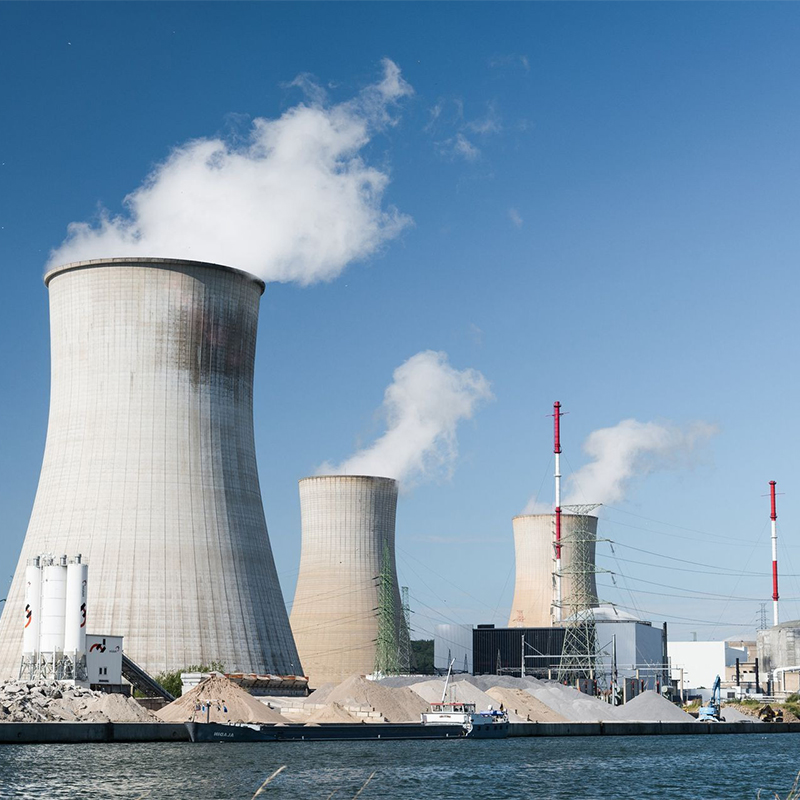
We Provide Cooling Tower Solution

Views: 0 Author: Cindy Publish Time: 2026-10-10 Origin: Site


If you are researching King Sun cooling towers, you are probably looking for more than a basic product description. You may want to know which type fits your application, how the tower works, what kind of fill it uses, and what to consider when replacement parts are needed.
That is exactly what this guide covers.
King Sun Industry has been involved in refrigeration, air conditioning, heat exchange and cooling equipment since 1978. Its current cooling tower portfolio includes crossflow, counterflow, closed-circuit, forced-draft, industrial and field-erected designs.
For buyers, engineers and maintenance teams, understanding these differences is important. A cooling tower is not simply a large fan sitting over a water basin. Think of it as a carefully designed heat-rejection machine. Every component—from the fan and water distribution system to the fill and drift eliminators—has a job to do.
A King Sun cooling tower is a mechanical heat-rejection system designed to remove heat from circulating water or, in closed-circuit configurations, from a process fluid.
The basic principle is straightforward. Hot water enters the tower, comes into contact with moving air, and transfers heat to the air. A portion of the water evaporates, carrying heat away from the system.
The result is cooler water that can be returned to an HVAC system or industrial process.
King Sun's product portfolio covers multiple tower configurations, allowing the equipment to be matched to different cooling loads, installation conditions and operating requirements.
But why are there so many different designs?
Because cooling applications are rarely identical.
A commercial building may prioritize compact dimensions and low operating noise. An industrial plant may care more about massive heat loads, durability and service access. A clean manufacturing process may benefit from a closed-circuit system.
The tower design needs to match the job.

King Sun Industry Co., Ltd. was founded in Taiwan in 1978 and describes itself as a manufacturer of cooling towers and air-conditioning system equipment. The company states that its products serve commercial buildings, industrial plants, medical institutions, electronics facilities and other HVAC and process applications.
Its current product line includes:
HKD crossflow square modular cooling towers
KFT counterflow square modular cooling towers
KLN counterflow bottle-type low-noise towers
KST-N bottle-type cooling towers
KSB forced-draft counterflow towers
KC closed-circulation cooling towers
KCC counterflow closed-circulation towers
KCF industrial cooling towers
KHT field-erected crossflow towers
KCW field-erected counterflow towers
King Sun also publishes certification information for several product series, including CTI certifications for HKD, KC, KFT and KFC models.
For buyers, this variety is useful because it means the brand is not tied to only one cooling tower architecture.
Although cooling tower designs vary, the fundamental process is based on heat and mass transfer.
Hot circulating water enters the tower and is distributed across the fill or heat-transfer surface. At the same time, a fan moves air through the tower.
As the water spreads over the fill, its surface area increases dramatically.
This is where cooling tower fill becomes important.
Instead of allowing water to fall directly from the top to the basin, the fill breaks the water into thin films or droplets. More water surface area means better contact with air.
Some water evaporates.
That evaporation removes heat.
The cooled water then collects in the basin and is pumped back into the cooling system.
It is a little like sweating. Your body does not need to evaporate all its water to cool down. A small amount of evaporation can remove a surprisingly large amount of heat.
A cooling tower applies the same basic physical idea on an industrial scale.

Choosing a King Sun cooling tower starts with understanding the available designs.
Different configurations provide different combinations of airflow, heat transfer, maintenance access, water quality tolerance and installation flexibility.
The HKD series is a crossflow square modular cooling tower.
In a crossflow tower, air generally moves horizontally across the falling water while water travels downward through the fill.
This configuration can be attractive when maintenance accessibility and modular installation are important.
King Sun states that the HKD series has undergone CTI performance testing, and its published product information describes hanging-type PVC fills intended to reduce clogging and icing concerns.
For replacement or refurbishment projects, understanding the original fill arrangement is especially important.
The KFT is a counterflow square modular cooling tower.
Here, water flows downward while air moves upward in the opposite direction.
Why use counterflow?
The opposing airflow direction can create effective contact between air and water throughout the fill section.
King Sun describes the KFT series as suitable for high heat-load industrial processes and large air-conditioning systems, emphasizing heat exchange and energy-saving performance.
For large cooling requirements, counterflow designs are often considered when the available footprint and thermal duty make this configuration attractive.
King Sun also offers bottle-type counterflow cooling towers.
The KLN series is described as a low-noise counterflow bottle-type cooling tower, while KST-N is another bottle-type counterflow configuration.
Bottle-type towers are common in HVAC applications where a relatively compact packaged cooling solution is required.
Their characteristic shape is not merely cosmetic. The tower geometry is designed around airflow, water distribution and heat-transfer requirements.
The KSB is a forced-draft, counterflow, single-side air-intake cooling tower.
In a forced-draft configuration, the fan arrangement pushes air into or through the tower rather than relying on an induced-draft fan at the discharge.
This type can be useful when the project requires a particular airflow arrangement or equipment configuration.
When evaluating a forced-draft system, engineers should pay attention to fan capacity, static pressure, airflow distribution and installation conditions.
The KC series is a closed-circulation cooling tower.
This is fundamentally different from a conventional open cooling tower.
In a closed-circuit system, the process fluid travels inside heat-exchanger coils while spray water and air remove heat from the coil surface.
King Sun states that its KC heat-exchanger coils use copper alloy C12200 and highlights the closed-loop design for applications where process-fluid cleanliness is important.
This can be a major advantage when contamination of the process fluid is a concern.
The KCC series combines closed-loop heat transfer with counterflow airflow.
The process fluid remains inside the coil while spray water moves downward and air moves upward.
This arrangement allows heat to move from the process fluid to the coil, from the coil to the spray water, and finally from the water to the air.
It is a multi-stage heat-transfer process—and every stage matters.
The KCF is designed for industrial applications.
King Sun's published KCF specifications describe axial-flow fans, adjustable blade angles and gearbox arrangements designed around CTI and AGMA requirements. The company also lists options such as vibration switches and oil-level switches.
For industrial users, these details matter because the tower may operate continuously under demanding conditions.
Reliability is not a luxury in a process plant. It is part of production.
For larger projects, King Sun also offers field-erected tower designs.
The KHT is a field-erected modular tower using a crossflow configuration, while the KCW is a field-erected modular tower using counterflow airflow.
These solutions can be considered when a packaged factory-assembled tower is not enough for the required cooling capacity.
The right cooling tower is ultimately about matching design with operating conditions.
Several characteristics deserve close attention.
Crossflow and counterflow are two of the most important cooling tower configurations.
In a crossflow tower, air travels approximately perpendicular to the falling water.
In a counterflow tower, air and water travel in opposite directions.
Neither configuration is automatically better for every project.
The right choice depends on cooling duty, footprint, water distribution, maintenance access, climate, airflow requirements and project economics.
Heat transfer is the heart of cooling tower performance.
A tower must provide sufficient water-air contact while maintaining suitable airflow.
If water distribution is poor, some fill areas may receive too much water while others remain underused.
If airflow is uneven, the same problem occurs from the air side.
Good performance is therefore a team effort involving the fan, fill, distribution system and tower geometry.
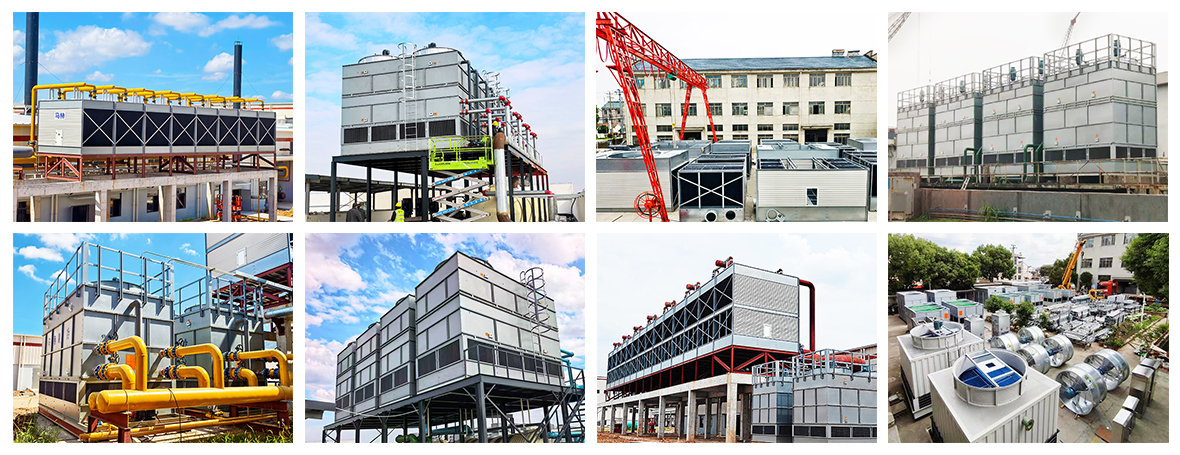
The fan is the engine that moves air through the tower.
King Sun's industrial KCF series, for example, uses axial-flow fan arrangements with adjustable blade angles and industrial gearbox options.
When maintaining or upgrading a cooling tower, do not look only at the fan motor.
Check:
Fan blade condition
Blade pitch
Motor performance
Gearbox condition
Shaft alignment
Vibration
Airflow obstruction
Fan stack condition
A dirty or damaged fan system can quietly reduce cooling performance while increasing energy consumption.
Fill is one of the most important components inside an evaporative cooling tower.
It increases the effective contact area between water and air.
Film fill creates thin sheets of flowing water across corrugated surfaces. Splash fill breaks falling water into droplets.
The appropriate choice depends heavily on water quality, temperature, suspended solids and the original tower design.
Closed-circuit cooling towers offer another approach.
Instead of exposing the process fluid directly to tower water and air, the process fluid remains inside coils.
This can help reduce contamination risk and may simplify process-fluid management.
For sensitive manufacturing applications, this distinction can be extremely important.
King Sun cooling tower systems can be used across a broad range of commercial and industrial environments.
Cooling towers are widely used in central chilled-water systems.
Large buildings such as:
Hotels
Office complexes
Shopping centers
Hospitals
Universities
Airports
may require cooling towers to reject heat from chillers.
For these applications, noise, energy consumption, footprint and maintenance accessibility can be major selection factors.
Industrial facilities often generate significant heat through manufacturing processes.
Cooling towers may support:
Chemical processing
Plastic manufacturing
Metal processing
Food production
Petrochemical operations
Machinery cooling
Process water systems
The required cooling duty can be much more demanding than a typical commercial HVAC installation.
Modern electronics generate substantial heat.
Data centers, semiconductor facilities and electronics manufacturing plants therefore require highly reliable heat-rejection systems.
For applications where process-fluid cleanliness is critical, closed-circuit cooling can be particularly attractive.
Large industrial facilities may use field-erected or industrial cooling tower systems because the cooling demand can be substantial.
In these environments, the tower is not simply an accessory.
It is part of the production system.
If cooling stops, production may stop.

If you already operate a King Sun cooling tower, eventually you may need replacement components.
The cooling tower fill deserves special attention.
Fill is continuously exposed to water, air, chemicals, microorganisms and temperature changes.
Over time, it can become:
Fouled
Scaled
Brittle
Cracked
Deformed
Blocked
Biologically contaminated
When the fill becomes severely damaged, water distribution and airflow can deteriorate.
The result?
Lower cooling performance.
Higher approach temperature.
Potentially higher fan or pump energy.
And, in serious cases, unstable operation.
Do not order replacement fill based only on the tower brand.
That is a common mistake.
You need to verify:
Tower model
Fill type
Fill dimensions
Sheet thickness
Flute or corrugation pattern
Block height
Block width and length
Water temperature
Water quality
Required thermal performance
A replacement fill should be engineered to work with the tower's existing water distribution and airflow conditions.
A good physical fit is not necessarily a good thermal fit.
The best tower is not necessarily the largest tower or the tower with the lowest purchase price.
It is the tower that meets the required cooling duty reliably and economically.
Start with the heat load.
You need to know the required heat rejection rather than simply guessing tower tonnage.
Important operating data includes:
Entering water temperature
Leaving water temperature
Design wet-bulb temperature
Water flow rate
Required approach
Operating hours
Seasonal conditions
These values provide the foundation for correct tower selection.
Water quality can make or break a cooling tower.
High levels of suspended solids, hardness, biological growth or other contaminants can accelerate fill fouling.
If the water is dirty, a fill with extremely narrow passages may create unnecessary maintenance problems.
Sometimes a wider-flute or splash-oriented solution is more appropriate.
The cheapest fill is rarely the cheapest solution over the entire service life.
Ambient wet-bulb temperature is critical for evaporative cooling tower design.
A tower operating in a hot and humid environment faces a different challenge from one operating in a dry climate.
Do not compare cooling tower performance without comparing design conditions.
Ask yourself a practical question:
Can your maintenance team easily inspect and clean the tower?
A technically excellent tower that is difficult to service can become expensive over time.
Consider access doors, basin access, fill inspection, fan maintenance, drift eliminator replacement and water treatment requirements.
Regular maintenance is essential for stable cooling tower performance.
A sensible maintenance program should include inspection of:
Fill
Nozzles
Distribution pipes
Drift eliminators
Fan blades
Motor
Gearbox
Bearings
Basin
Makeup-water system
Blowdown system
Structural components
Water treatment should also be managed according to the actual water chemistry.
Look for scale.
Look for biological growth.
Look for corrosion.
And do not ignore unusual vibration or noise.
A cooling tower often gives you warning signs before a major failure occurs.
Listen to it.
Replacing an entire cooling tower is not always necessary.
In many cases, upgrading individual components can extend the useful life of existing equipment.
Potential upgrades may include:
Cooling tower fill
Drift eliminators
Nozzles
Fan blades
Motors
Gearboxes
Water distribution components
Structural components
Among these, fill replacement is one of the most common ways to restore evaporative heat-transfer performance.
However, the replacement should be evaluated carefully.
If the original fill has failed because of poor water quality, installing identical fill without addressing the root cause may simply repeat the problem.
That is why an effective upgrade begins with diagnosis.
For customers looking for cooling tower components, replacement fill and related cooling tower solutions, Mach Industry (Zhejiang) Co.,Ltd provides manufacturing support for industrial cooling applications.
Mach Industry (Zhejiang) Co.,Ltd

For a King Sun cooling tower replacement project, Mach can be positioned as a component manufacturer and supplier rather than implying an official relationship with King Sun.
This distinction is important.
If you need replacement fill for an existing King Sun tower, the goal is to develop a compatible solution based on the actual tower dimensions and operating conditions.
Mach can help evaluate factors such as:
Cooling tower fill dimensions
Film or splash fill requirements
PVC or PP material selection
Water temperature
Water quality
Fill spacing
Airflow requirements
Replacement quantity
Application conditions
The objective is simple: make the replacement component work for the actual cooling system.
Before purchasing a King Sun cooling tower or replacement component, use this checklist:
For a new cooling tower:
Define the heat load.
Confirm water flow.
Confirm entering and leaving water temperatures.
Determine design wet-bulb temperature.
Select crossflow or counterflow.
Evaluate noise requirements.
Check installation space.
Consider maintenance access.
Review certification requirements.
Calculate lifecycle cost.
For replacement fill:
Confirm the King Sun tower model.
Measure the existing fill.
Identify the original fill type.
Check water quality.
Check operating temperature.
Determine whether fouling is a problem.
Select suitable PVC or PP material.
Confirm airflow and water distribution.
Request dimensional and technical confirmation before production.
This simple process can prevent expensive mistakes.

A King Sun cooling tower is not a single standard product. It is a broad family of cooling solutions covering crossflow, counterflow, bottle-type, forced-draft, closed-circuit, industrial and field-erected configurations.
The right choice depends on the application.
Need compact HVAC cooling? A modular or bottle-type configuration may be appropriate.
Need industrial heat rejection? A counterflow or industrial design may make more sense.
Need to protect process-fluid quality? A closed-circuit cooling tower deserves serious consideration.
Already have a King Sun tower and need replacement parts? Start with the actual equipment rather than the brand name. Model, dimensions, water quality, temperature and operating conditions all matter.
And when it comes to cooling tower fill, remember one thing: the right fill is not simply the one that fits inside the tower. It is the one that fits the tower's thermal, hydraulic and operating requirements.
For replacement fill, cooling tower components and customized manufacturing support, Mach Industry (Zhejiang) Co.,Ltd can provide a practical supplier option for industrial cooling projects.
The best cooling tower is ultimately the one that keeps doing its job—efficiently, reliably and economically—long after installation day.