We Provide Cooling Tower Solution

Views: 0 Author: Site Editor Publish Time: 2025-11-26 Origin: Site


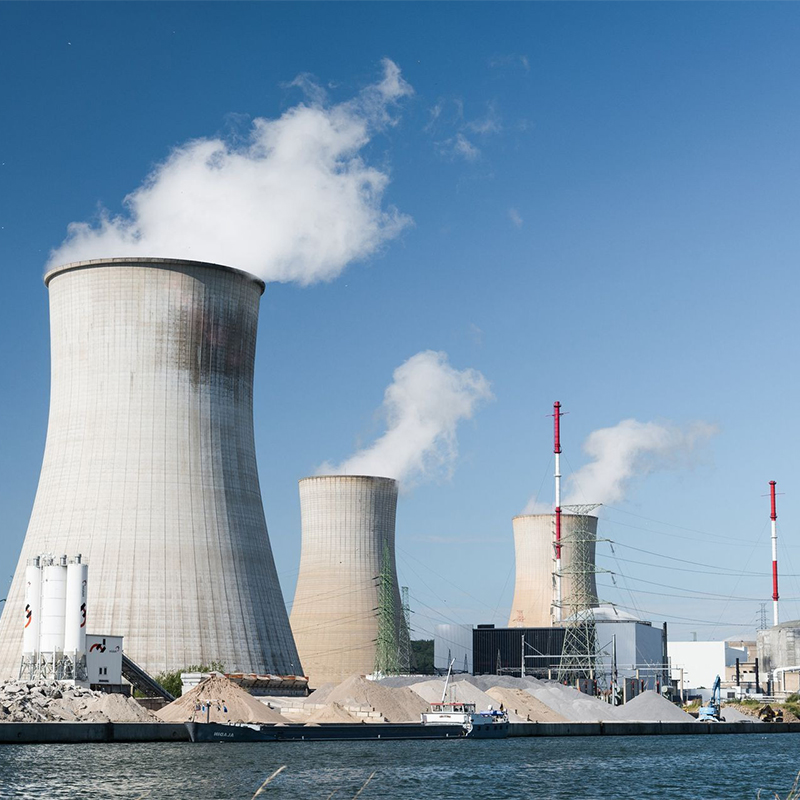
A natural draft cooling tower is a cooling device that drives airflow without mechanical fans. It relies on the chimney effect, which is generated by the density difference between hot and cold air. This effect allows cool air to naturally enter from the bottom of the tower and warm moist air to rise and exit from the top, enabling efficient evaporative cooling.
Such cooling towers are commonly used in thermal power plants, nuclear power plants, and large-scale chemical facilities, serving as a critical component of industrial cooling systems.
A natural draft cooling tower typically features a tall hyperbolic structure composed of:
Tower Shell (Hyperbolic Shell): A double-curved shape that enhances stability and airflow efficiency.
Water Distribution System: Spray pipes and nozzles distribute warm water evenly over the fill.
Fill Pack: Increases the contact surface area between water and air, accelerating heat exchange.
Drift Eliminator: Prevents water droplets from escaping with the airflow.
Cold-Water Basin: Collects cooled circulating water at the bottom of the tower.

The operation of a natural draft cooling tower is driven by:
Hot air rising + cool air entering → continuous airflow → evaporative cooling
The process includes the following steps:
Water from the industrial system (typically 30–45°C) is distributed uniformly over the fill pack via spray nozzles.
As water warms the internal air, the heated air becomes lighter and rises.
This creates a negative pressure area inside the tower, drawing cool, dense outside air into the bottom.
In the fill:
Water flows downward
Air flows upward
Their counterflow contact leads to:
Sensible heat transfer: Direct heat exchange due to temperature difference
Latent heat transfer: A small portion of water evaporates and removes a large amount of heat (dominant cooling mechanism)
As air becomes hotter and lighter, it rises rapidly toward the top, creating a strong natural draft and promoting continuous airflow.
After evaporative cooling, water temperature typically drops from around 40°C to 28–32°C and flows into the cold-water basin for recirculation.
The contraction and expansion shape increases airflow speed and improves natural draft strength.
The tower relies entirely on natural airflow, making it highly energy-efficient for long-term, large-scale operation.
Airflow inside the tower is smooth and consistent, improving cooling stability.
| Heat Transfer Type | Description | Proportion |
|---|---|---|
| Sensible Heat Transfer | Direct temperature drop of water | 15%–25% |
| Latent Heat Transfer | Evaporation removes large latent heat | 70%–80% |
| Radiation | Very minor effect | <5% |
| Aspect | Natural Draft Cooling Tower | Mechanical Draft Cooling Tower |
|---|---|---|
| Airflow Source | Natural draft | Fan-driven |
| Energy Consumption | Very low | High |
| Construction Cost | High | Lower |
| Structure Size | Very large (100–200m typical) | Small or medium |
| Maintenance | Low | High (fan maintenance required) |
| Typical Applications | Power plants, chemical plants | Buildings, industrial facilities |
Thermal power generation
Nuclear power stations
Chemical process cooling
Oil refining
Steel and metallurgical industries
A natural draft cooling tower uses the density difference between cold and hot air to generate natural upward airflow and achieve evaporative cooling.
Its optimized structure provides excellent energy efficiency and stable cooling performance, making it ideal for large industrial applications. Understanding its working principles allows engineers to design, select, operate, and maintain cooling towers more effectively.