We Provide Cooling Tower Solution

Views: 0 Author: Site Editor Publish Time: 2026-01-03 Origin: Site


In modern HVAC systems, especially in large commercial buildings and industrial facilities, cooling is never handled by a single piece of equipment. Instead, it’s a carefully coordinated process. At the center of this process lies a powerful partnership: the chiller and cooling tower.
Think of them as teammates. The chiller removes heat from the building, while the cooling tower helps get rid of that heat efficiently. One cannot perform at its best without the other. Understanding their relationship is essential for system design, energy efficiency, and long-term operational stability.
So how exactly do chillers and cooling towers work together in HVAC systems? Let’s break it down—clearly, practically, and without unnecessary jargon.
Large HVAC systems rely on chilled water to provide cooling across vast spaces. This chilled water doesn’t appear out of nowhere—it’s produced, circulated, and continuously cooled through a closed-loop system.
At a high level:
The chiller creates chilled water by removing heat.
The cooling tower rejects that heat into the atmosphere.
Together, they form the backbone of centralized HVAC cooling plants used in offices, hospitals, data centers, hotels, and industrial plants.
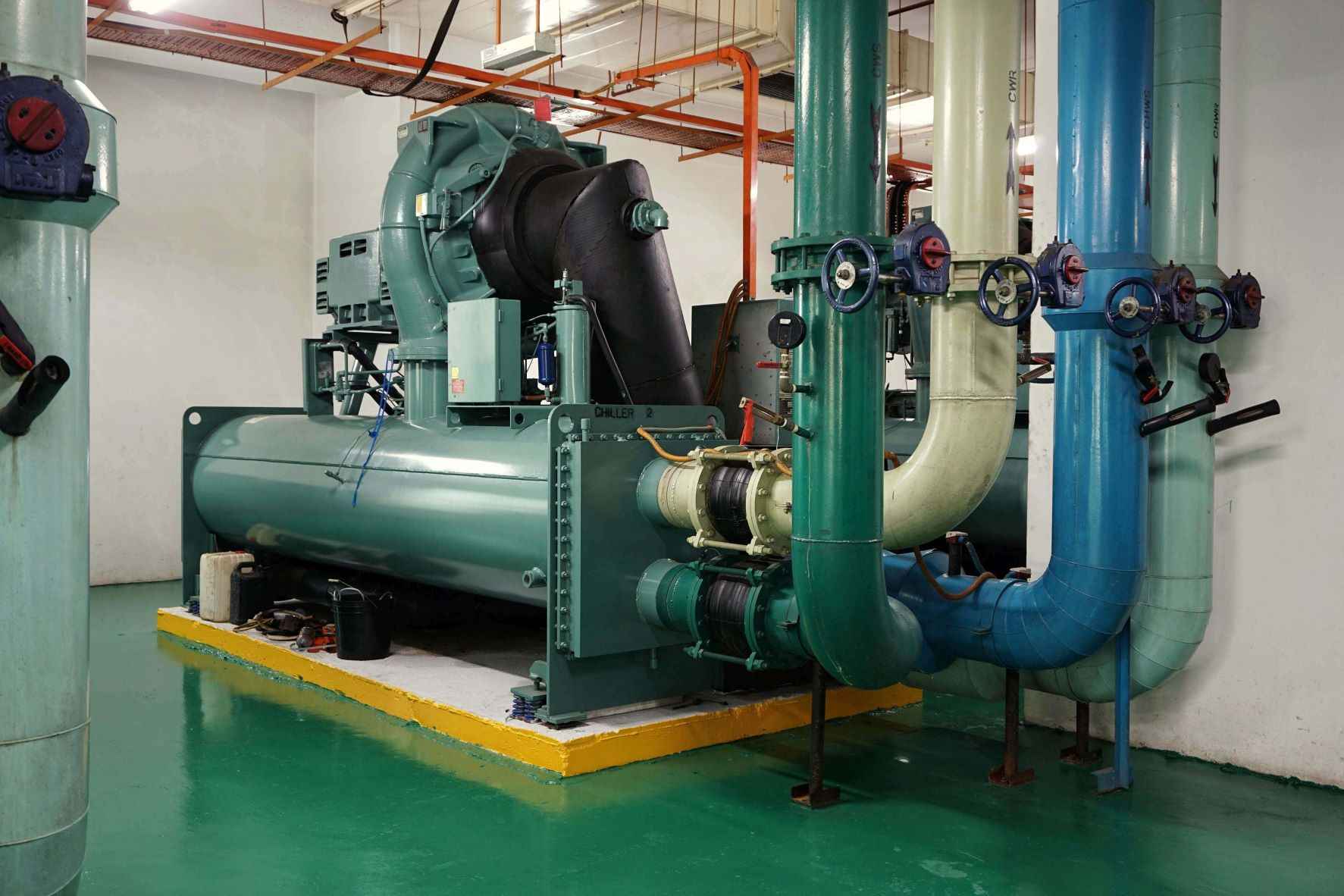
A chiller is the core cooling machine in an HVAC system. Its job is to extract heat from water and deliver chilled water to air handling units (AHUs), fan coil units (FCUs), or process equipment.
This chilled water absorbs heat from indoor air or industrial processes and then returns to the chiller to be cooled again. It’s a continuous cycle.
There are several chiller types, but the most common classification is based on how heat is rejected:
Air-cooled chillers
Water-cooled chillers
Air-cooled chillers reject heat directly to ambient air using fans and condensers. They’re simpler but less efficient for large loads.
Water-cooled chillers, on the other hand, use water to remove heat from the condenser—and this is where the cooling tower becomes essential. These systems are more efficient, quieter, and better suited for large HVAC applications.
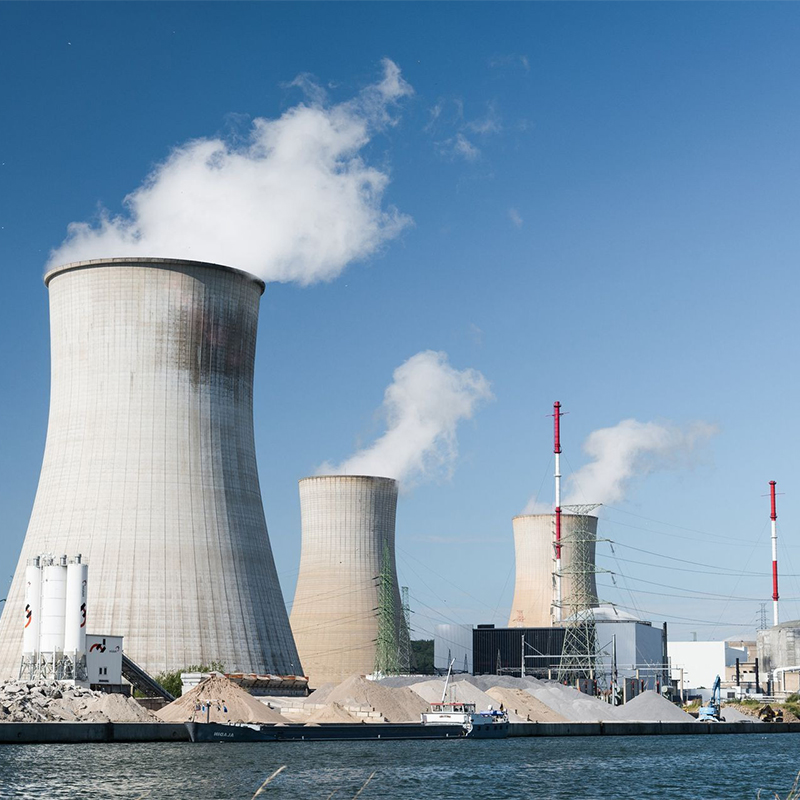
A cooling tower is a heat rejection device. Its job is to remove heat from warm condenser water by transferring it to the atmosphere, mainly through evaporation.
Without a cooling tower, a water-cooled chiller would quickly overheat and shut down.
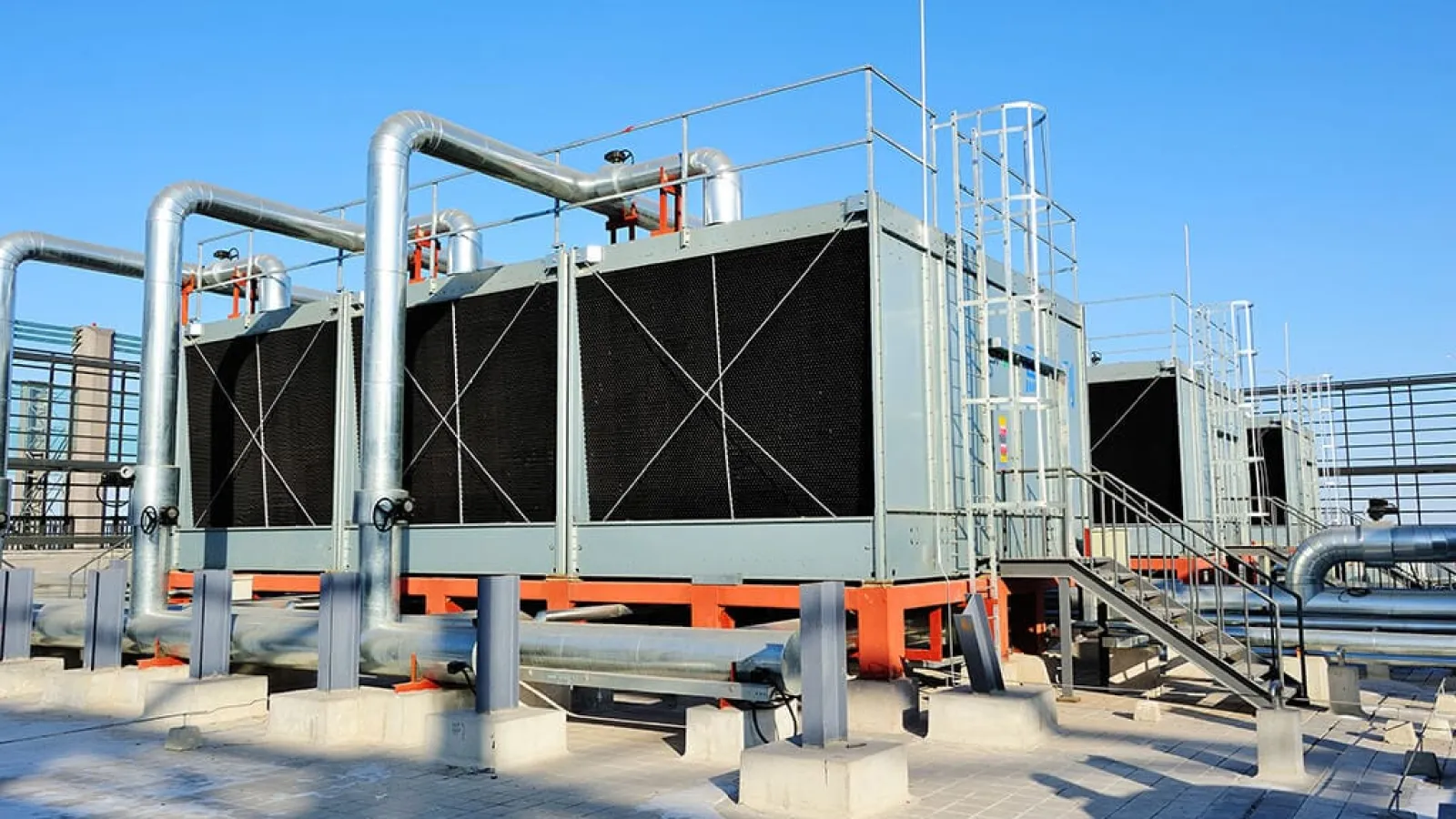
A typical cooling tower includes:
Fill media for heat exchange
Fans to move air
Water distribution system
Drift eliminators to minimize water loss
Each component plays a role in maximizing heat rejection efficiency.
The relationship between a chiller and cooling tower is all about heat movement.
Here’s the simple version:
The chiller absorbs heat from the building.
That heat moves to the condenser.
The condenser water carries the heat to the cooling tower.
The cooling tower releases the heat into the air.
It’s like taking heat out of a room and throwing it outside.
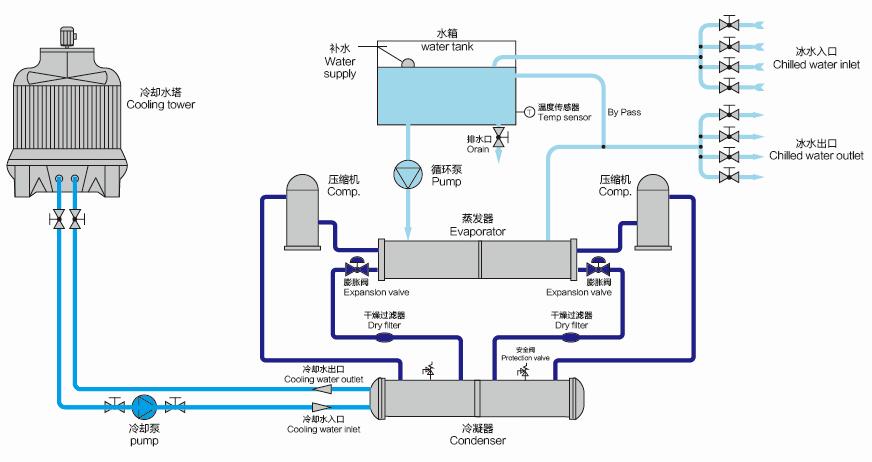
Inside the chiller, refrigerant absorbs heat and transfers it to condenser water. This hot water flows to the cooling tower, where air and evaporation remove the heat before the water returns to the chiller.
This loop connects the chiller and cooling tower. Its design—flow rate, temperature difference, and water quality—directly affects system efficiency and reliability.
Water-cooled chillers rely on cooling towers to operate continuously. Without proper heat rejection:
Condensing pressure rises
Energy consumption increases
Chiller lifespan decreases
A properly selected cooling tower allows the chiller to operate at optimal efficiency, especially in high-load or high-temperature environments.
In a typical HVAC plant, there are two separate water loops:
Chilled water loop (inside the building)
Condenser water loop (between chiller and cooling tower)
These loops never mix, but they work together to maintain thermal balance across the system.
Cooling towers can be designed as open or closed loop systems, depending on application requirements.
Open loop systems are more cost-effective and widely used.
Closed loop systems offer better water quality control and protection for sensitive equipment.
The choice depends on climate, water quality, and maintenance strategy.
A chiller and cooling tower must be properly matched. When they’re not, efficiency drops fast.
Oversized or undersized cooling towers can cause:
Higher power consumption
Frequent cycling
Reduced cooling capacity
Typical problems include:
Fouled condenser tubes
Poor airflow
Improper control settings
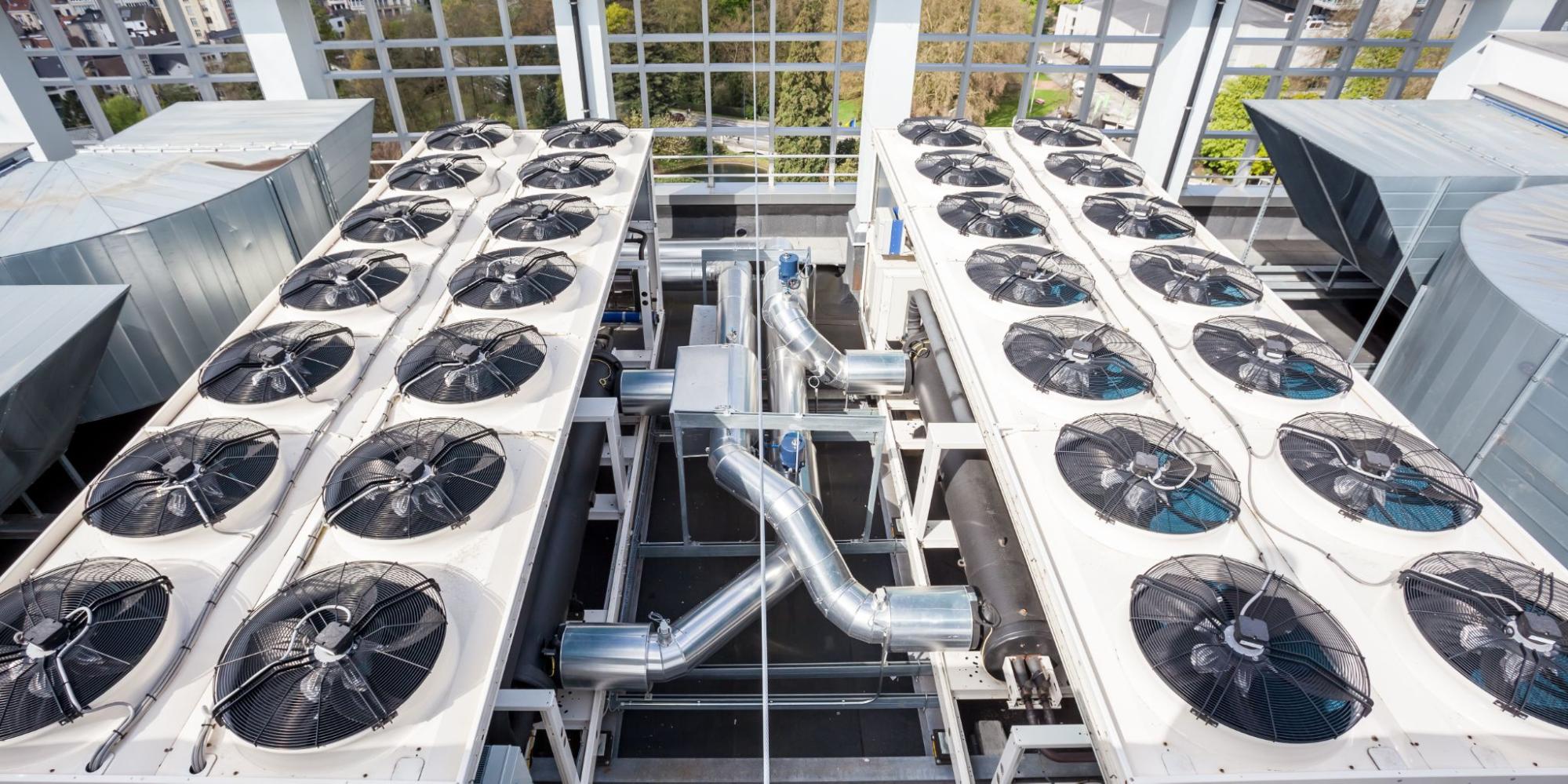
Cooling towers use water to remove heat. Evaporation, blowdown, and makeup water must be carefully managed to balance efficiency and sustainability.
Proper design and water treatment help reduce waste while maintaining performance.
When something goes wrong, the impact is rarely isolated.
Poor water treatment leads to scale buildup, biological growth, and corrosion. These issues reduce heat transfer and shorten equipment life for both chillers and cooling towers.
Optimization isn’t about adding more equipment—it’s about smarter operation.
Using variable frequency drives (VFDs) on cooling tower fans and condenser pumps allows the system to respond dynamically to real-time cooling demand, significantly reducing energy use.
Commercial HVAC systems focus on comfort, noise control, and energy efficiency.
Industrial systems prioritize process stability and continuous operation.
Despite different goals, both rely on the same fundamental chiller–cooling tower relationship.
Mach Cooling (https://www.machcooling.com/) is a professional manufacturer specializing in high-quality cooling tower solutions designed to work seamlessly with water-cooled chiller systems.
With strong engineering capability, strict quality control, and extensive international project experience, Mach Cooling supports:
Commercial HVAC plants
Industrial cooling systems
Power and process cooling applications
Their cooling towers are built for efficiency, durability, and global standards compliance.
Do all chillers need cooling towers?
No. Only water-cooled chillers require cooling towers.
Which system is more efficient?
Water-cooled chillers combined with cooling towers are generally more efficient for large HVAC systems.
Can cooling towers reduce energy costs?
Yes. Properly selected and controlled cooling towers significantly lower chiller power consumption.
The relationship between chiller and cooling tower in HVAC systems is fundamental and inseparable. One produces cooling, the other makes that cooling possible.
When properly designed, matched, and maintained, this partnership delivers:
High energy efficiency
Stable system performance
Long service life
Choosing the right cooling tower partner—like Mach Cooling—ensures your HVAC system operates smoothly, efficiently, and reliably for years to come.