We Provide Cooling Tower Solution

Views: 0 Author: Site Editor Publish Time: 2026-01-16 Origin: Site


Cooling towers are often the unsung heroes of industrial and commercial facilities. They quietly remove heat, support processes, and keep buildings comfortable. But hidden inside these structures is a small component that plays an outsized role in efficiency: the cooling tower louver.
Think of louvers as the “eyelids” of a cooling tower. When designed properly, they protect, regulate, and optimize everything happening inside. Poorly designed louvers, on the other hand, lead to excessive water loss, higher energy bills, and subpar performance.
In this article, we’ll explore how proper louver design reduces water loss and energy consumption, and why smart manufacturers like Mach Cooling treat louver engineering as a science, not an afterthought.
Cooling tower louvers are often misunderstood. Many people assume they’re just panels that keep water from splashing out. In reality, louvers are airflow managers, water guardians, and energy savers rolled into one.
A well-designed louver system balances:
Air intake
Water retention
Drift reduction
Structural durability
Ignoring any of these factors can compromise cooling efficiency and increase operational costs.
Water and energy are the lifeblood of cooling tower operation. Losing too much of either can spiral operating costs out of control.
Evaporation is the mechanism that removes heat. But uncontrolled evaporation caused by turbulent airflow increases the need for make-up water, raising water costs and chemical treatment requirements.
Drift and splash-out are direct losses. They increase:
Water consumption
Maintenance due to scaling and corrosion
Energy use because the system compensates for lost water
Proper louver design acts like a traffic controller, directing airflow to keep water where it belongs.
At their core, louvers are slatted panels installed on the air intake sides of cooling towers.
Louvers allow sufficient airflow while:
Preventing water escape
Blocking sunlight and debris
By controlling air velocity and direction, louvers prevent high-speed air from pulling droplets out of the tower, much like slowing wind prevents leaves from blowing away.
Properly angled louvers break water momentum, redirect falling droplets back into the basin, and reduce sidewall wetting.
Uniform airflow reduces pressure differentials, which minimizes droplet carryover and improves the performance of drift eliminators.
Smooth airflow lowers static pressure in the tower, reducing fan motor load. Think of it as breathing through an open mouth instead of a straw—the airflow is easier and less energy-intensive.
When airflow enters evenly across the fill media:
Heat transfer improves
Approach temperatures decrease
Fans work less to achieve the same cooling effect
This translates into tangible energy savings.
The angle of louvers controls air velocity, while spacing affects both pressure drop and structural rigidity. Incorrect angles or spacing can dramatically increase water loss and energy consumption.
High-quality FRP or PVC louvers, like those used by Mach Cooling, resist:
UV degradation
Chemical attack
Warping over time
Loose or vibrating louvers create gaps—gaps lead to water and energy losses.
Typical mistakes include:
Oversized spacing
Inconsistent angles
Weak support frames
These design errors may save money upfront but cost far more over the cooling tower’s lifespan.
Fixed louvers offer:
Lower maintenance
Consistent performance
Adjustable louvers provide flexibility but require:
Regular calibration
Skilled maintenance
For most industrial towers, high-quality fixed louvers provide the best balance of efficiency and reliability.
From power plants to commercial HVAC systems, proper louver design:
Stabilizes airflow in high-wind environments
Reduces seasonal efficiency swings
Supports regulatory compliance
Upgrading louvers is one of the highest ROI retrofits available. Benefits include:
Immediate water savings
Reduced fan energy usage
Extended tower lifespan
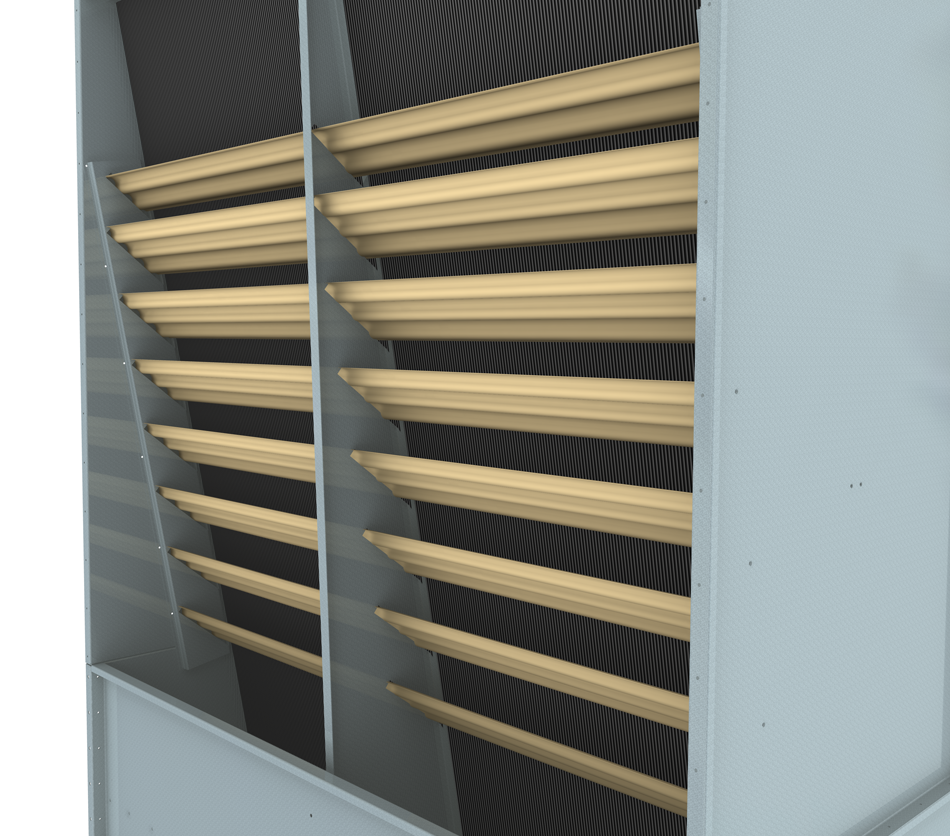

At Mach Cooling, louver design is treated as a critical engineering process. Their approach includes:
Application-specific airflow modeling
Durable FRP construction
Easy installation and replacement
This ensures cooling towers achieve maximum water and energy efficiency under real-world conditions.
Even the best louvers need care:
Inspect for cracks or deformation
Clean biological buildup
Tighten mounting hardware
Regular maintenance keeps efficiency locked in year after year.
Proper louver design can deliver:
5–15% reduction in make-up water
3–10% fan energy savings
Faster payback than most other mechanical upgrades
Lower water loss and energy consumption translate to:
Reduced freshwater demand
Lower chemical treatment usage
Smaller environmental footprint
Good louver design supports both operational efficiency and sustainability goals.
Cooling tower louvers may seem like a minor detail, but they quietly control water efficiency, energy consumption, and long-term reliability.
When designed properly—and manufactured by experts like Mach Cooling—louvers transform from passive panels into active efficiency tools. If you’re serious about reducing operating costs and improving sustainability, start by evaluating your louvers—sometimes the smallest components make the biggest difference.