We Provide Cooling Tower Solution

Views: 0 Author: Site Editor Publish Time: 2025-11-26 Origin: Site


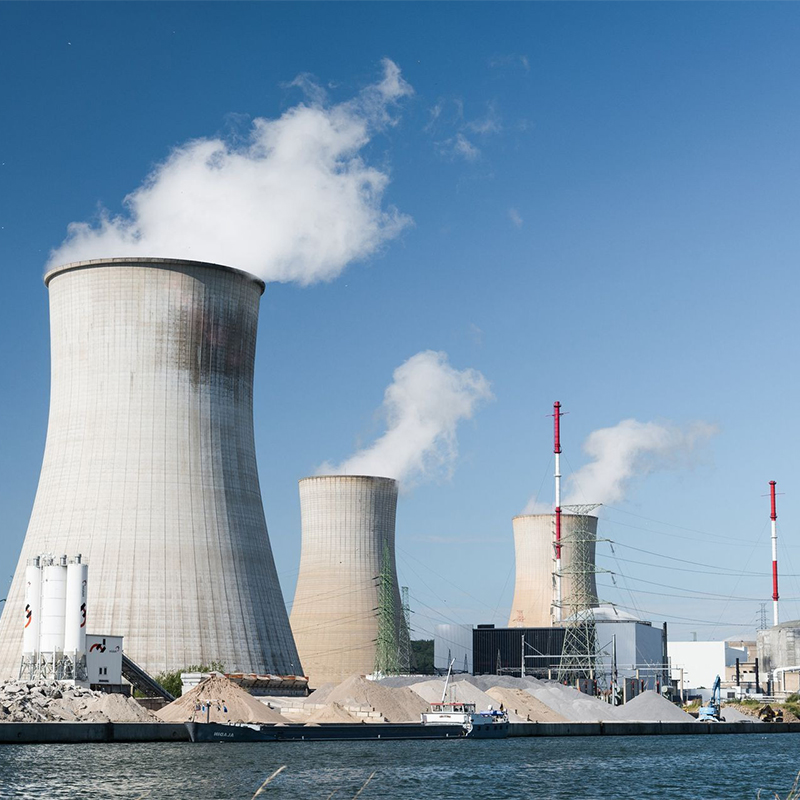
The hyperbolic cooling tower is one of the most iconic structures in power plants, chemical facilities, and large industrial sites. Its towering “hourglass-like” shape is not only aesthetically striking but also highly efficient in fluid dynamics.
This article explains the working principles, internal structure, and heat-exchange mechanisms of hyperbolic cooling towers, supported by diagrams and tables for easier understanding.
A typical hyperbolic cooling tower consists of the following key parts:
Hyperbolic Shell
A double-curved structure that enhances strength while reducing construction materials.
Water Distribution System
Includes spray pipes and nozzles that distribute warm water uniformly across the fill.
Fill Pack
Provides a large surface area for heat exchange between water and air — the core of evaporative cooling.
Drift Eliminator
Reduces water droplet loss.
Cold-Water Basin
Collects cooled circulating water at the bottom of the tower.

Hyperbolic cooling towers primarily rely on natural draft to drive airflow through the tower, enabling efficient heat exchange between water and air. The core mechanism is evaporative cooling.
Hot circulating water from equipment is sprayed downward onto the fill pack.
Warm air inside the tower becomes less dense and rises, drawing in cooler, denser air from outside.
The fill increases water surface area and promotes mass transfer.
Only 1–2% of the water evaporates, yet this removes substantial heat, lowering the temperature of the remaining water.
The cooled water falls into the cold-water basin and is pumped back into the industrial system.

The contraction-expansion geometry enhances the chimney effect, accelerating upward airflow.
The double-curved shell has superior structural strength, suitable for large power plants exposed to strong winds.
Central airflow accelerates upward while peripheral air continuously replenishes from outside.
As water flows through the fill, a small portion of it evaporates, requiring significant latent heat. This decreases the temperature of the remaining water.
| Heat Transfer Type | Description | Proportion |
|---|---|---|
| Sensible Heat Transfer | Direct water temperature drop | 15–25% |
| Latent Heat Transfer | Evaporation absorbs latent heat | 70–80% |
| Radiation | Very small effect | <5% |
| Item | Hyperbolic Natural Draft Tower | Mechanical Draft Cooling Tower |
|---|---|---|
| Air Movement Force | Natural draft, no fans needed | Fans create airflow |
| Energy Consumption | Very low | Higher |
| Size | Very large (e.g., power plants) | Small to medium |
| Maintenance Cost | Low | High (fan maintenance) |
| Initial Construction Cost | High | Relatively low |
Thermal power plants
Nuclear power plants
Steel and metallurgical plants
Chemical and petrochemical facilities
Large circulating water systems
The hyperbolic cooling tower is a remarkable combination of engineering and natural physics. Its natural draft design, large scale, and efficient evaporative cooling make it the most reliable and energy-saving solution for large industrial cooling systems.
Understanding its working principles helps engineers design, operate, and optimize cooling performance more effectively.