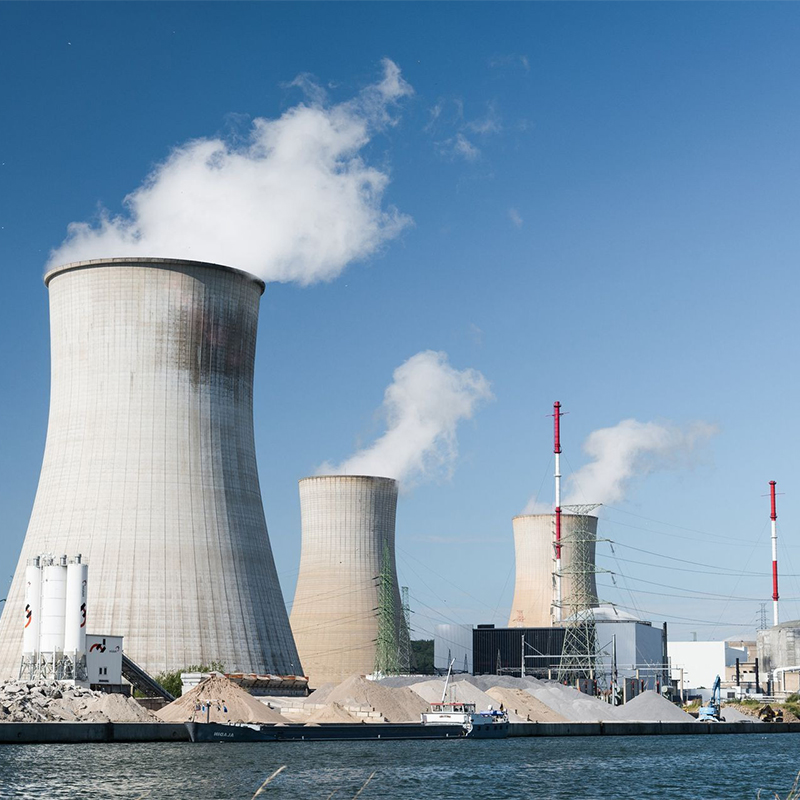
We Provide Cooling Tower Solution

Views: 0 Author: Site Editor Publish Time: 2025-11-25 Origin: Site


In modern industrial facilities and large commercial buildings, two essential pieces of cooling equipment often appear together: the chiller and the cooling tower.
This article explains how each device works, how they operate together, their system components, key parameters, and—using Mach Cooling Co., Ltd. as an example—how manufacturers support system design, selection, and maintenance.
This helps engineers, technicians, and project managers better understand system operation, optimize performance, reduce energy consumption, and extend equipment lifespan.
A chiller removes heat from water (or another medium) through the refrigeration cycle.
In a typical water-cooled chiller, chilled water enters the evaporator, where refrigerant absorbs heat from the water. The refrigerant evaporates into gas, is compressed to high pressure, releases heat at the condenser, and becomes liquid again. After expansion and pressure reduction, it re-enters the evaporator to repeat the cycle.
Evaporator – absorbs heat from chilled water.
Compressor – pressurizes low-pressure gas into high-temperature vapor.
Condenser – releases heat to cooling water from the cooling tower.
Expansion valve – reduces refrigerant pressure and temperature.
Chilled-water & cooling-water loops – transport heat to and from the chiller.
A cooling tower cools hot water (from the chiller condenser) by bringing water and air into contact.
Hot water is sprayed over fill media, increasing surface area. Airflow—natural draft or fan-powered mechanical draft—causes a small portion of water to evaporate, removing heat and cooling the remaining water before it returns to the condenser.
Spray or water distribution system
Fill media – increases heat exchange surface
Fans – drive airflow
Basin & circulating pump – collect and supply cooling water
Drift eliminators – reduce water loss
Water-cooled chillers use cooling water from the cooling tower to condense refrigerant, greatly improving efficiency.
Cooling towers can achieve lower heat-rejection temperatures than air-cooled systems.
The combination is widely used in buildings with large cooling loads, industrial plants, and precise-temperature control environments.
A chiller + cooling tower system follows this cycle:
The chiller sends chilled water to AHUs, FCUs, or process equipment.
Warm return water flows back to the chiller evaporator.
In the chiller condenser, refrigerant heat is transferred to cooling water.
Hot cooling water is pumped to the cooling tower.
The cooling tower removes heat through evaporation and airflow.
Cooled water returns to the condenser, and the cycle repeats.
| Loop | Inlet Temp | Outlet Temp | Description |
|---|---|---|---|
| Chilled-Water Loop | ~6 °C supply | ~12 °C return | Provides cooling to the building/equipment. |
| Cooling-Water Loop (Condenser Water) | ~27 °C to condenser | ~32 °C from condenser | Removes heat from chiller refrigerant. |
| Cooling Tower Outlet | ~22–25 °C | Depends on wet-bulb temperature | Sends cooled water back to the chiller. |
As a professional cooling-equipment manufacturer, Mach Cooling supports users with:
Equipment Selection
Recommending suitable chillers and cooling towers based on cooling load, ambient conditions, and process requirements.
System Integration
Ensuring proper matching of pumps, pipelines, cooling tower capacity, and control systems.
Installation & Commissioning
On-site support to achieve stable, efficient operation.
Maintenance Guidance
Water treatment, anti-corrosion measures, periodic inspection.
Energy-Saving Solutions
Improving cooling tower temperature control, optimizing fan operation, reducing water loss.
Cooling-water & wet-bulb temperature difference
Determines the minimum cooling tower outlet temperature.
Chiller condensing temperature
Lower condensing temperature = higher chiller efficiency.
Water flowrate and velocity
Prevents scaling and ensures effective heat transfer.
Fill media and fan selection
Directly affect tower performance.
Water treatment
Essential to avoid scaling, corrosion, and biological growth.
Inspect cooling tower nozzles, fill, and water distribution regularly.
Ensure cooling-water quality meets standards to reduce scaling in the condenser.
Maintain fan belts, bearings, and motor assemblies.
Control cooling-tower blowdown to maintain concentration ratio.
For chillers:
Check compressor condition
Monitor refrigerant levels
Observe chilled-water supply temperature
Identify signs of system issues:
High return-water temperature
Excessive noise or vibration
Reduced cooling capacity
This article explained the working principles of chillers and cooling towers, as well as how they cooperate to form an efficient cooling system.
Manufacturers such as Mach Cooling play crucial roles in system design, equipment selection, installation, maintenance, and optimization.
Proper design, correct operation, and regular maintenance are key to ensuring long-term system efficiency.
Future cooling systems will increasingly focus on:
Energy efficiency
Smart monitoring and control
Water-saving technologies
New fill materials and improved airflow designs
Working with experienced manufacturers like Mach Cooling helps businesses achieve stable, efficient, and sustainable cooling performance.