We Provide Cooling Tower Solution

Views: 0 Author: Site Editor Publish Time: 2026-02-25 Origin: Site


Cooling tower refrigeration capacity calculation might sound intimidating at first, but once you break it down, it’s actually very logical. Whether you’re an engineer, a project manager, or a buyer comparing suppliers, getting the capacity right is one of the most important decisions you’ll make in any cooling system.
Choose too small, and your system overheats.
Choose too big, and you burn money every day on wasted energy.
This guide walks you through the principles, calculations, and selection logic behind cooling tower refrigeration capacity—in clear, human language—while reflecting real-world engineering practices used by experienced manufacturers such as Mach Cooling.

Cooling towers are a critical part of industrial refrigeration and HVAC systems. Their job is simple in theory: remove heat from circulating water and release it into the atmosphere. In practice, however, performance depends heavily on accurate capacity calculation and correct selection.
A cooling tower that looks good on paper but fails in real operating conditions can shut down an entire plant. That’s why understanding refrigeration capacity isn’t optional—it’s essential.
Cooling tower refrigeration capacity refers to the amount of heat a cooling tower can reject per unit of time. This heat typically comes from chillers, condensers, or industrial processes.
It answers a simple but crucial question:
How much heat can the cooling tower safely and continuously remove?
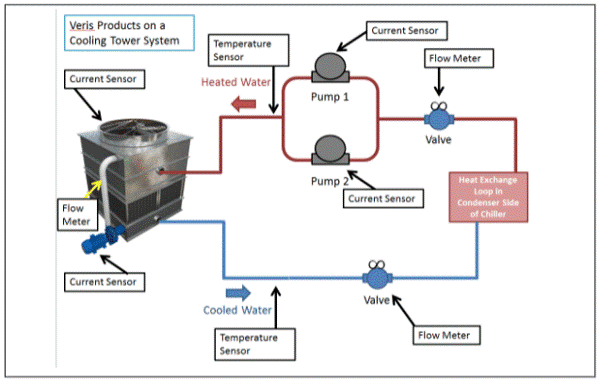
Think of refrigeration capacity like the engine size of a truck. If the engine is too small, it struggles uphill. If it’s too big, you waste fuel.
Accurate capacity calculation helps:
Maintain stable operating temperatures
Improve chiller efficiency
Reduce energy consumption
Extend equipment lifespan
Avoid costly redesigns later
Cooling towers rely primarily on evaporative cooling. Hot water flows over fill media while air passes through. A small portion of the water evaporates, and in doing so, carries heat away from the remaining water.
Only about 1–2% of the circulating water evaporates, yet this tiny amount removes the majority of the heat. It’s the same principle as sweat cooling your body—simple, natural, and highly efficient.
Heat load is the foundation of all capacity calculations. It includes:
Chiller condenser heat
Process-generated heat
Compressor energy converted to heat
Without accurate heat load data, capacity selection becomes guesswork.
The temperature difference between hot water entering the tower and cooled water leaving it (ΔT) directly impacts capacity. A larger ΔT allows more heat to be rejected.
Wet bulb temperature is one of the most critical design parameters. Cooling towers cool water toward the wet bulb temperature, not the dry bulb temperature.
Lower wet bulb temperatures allow higher cooling efficiency.
The more water flowing through the system, the more heat it can carry. However, the cooling tower must be designed to handle that flow efficiently.
1 TR equals:
3,024 kcal/hr
3.517 kW
This unit is still widely used in HVAC and industrial cooling projects.
These units are commonly used in engineering specifications and international projects, especially outside North America.
The standard heat rejection formula is:
Q = m × Cp × ΔT
Where:
Q = heat load (kcal/hr)
m = water flow rate (kg/hr)
Cp = specific heat of water (1 kcal/kg·°C)
ΔT = temperature difference (°C)
Assume:
Water flow rate: 100 m³/hr
Temperature difference: 5°C
Calculation:
Q = 100,000 × 1 × 5
Q = 500,000 kcal/hr
This equals approximately 165 TR of cooling tower capacity.
For early-stage planning only:
1 TR ≈ 3 GPM
1 TR ≈ 0.68 m³/hr
This method should never replace detailed calculations during final selection.
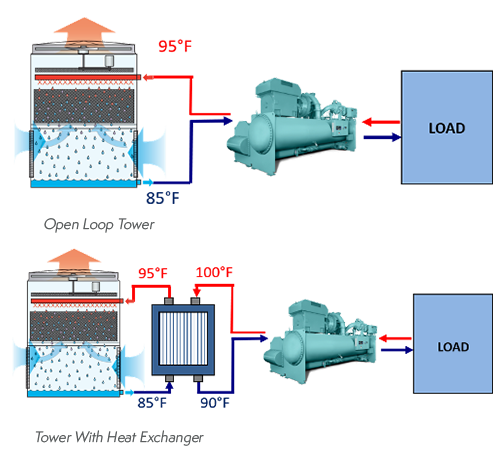

Open cooling towers allow direct contact between water and air. They offer high thermal efficiency and are widely used in industrial applications.
In closed circuit designs, process fluid flows inside coils and does not contact air directly. This protects fluid quality and reduces contamination.
Hybrid towers combine wet and dry cooling modes. They are ideal for projects that require water savings and environmental compliance.
Cooling towers must reject not only the cooling load but also the heat generated by the chiller compressor. Typically, this adds 25–30% extra heat load.
For example, a 500 TR chiller often requires a cooling tower rated at 600–650 TR.
Manufacturers like Mach Cooling design cooling towers by looking at the entire system, not just individual components.
Undersized cooling towers can cause:
High condensing pressure
Chiller trips
Reduced production capacity
Oversized cooling towers can lead to:
Higher capital investment
Lower fan efficiency
Unstable temperature control
The best solution is accurate calculation and proper selection, not oversizing “just in case.”

Cooling tower refrigeration systems are widely used in:
Power generation plants
Chemical and petrochemical facilities
Food and beverage processing
Central HVAC systems
Data centers and electronics cooling
A correctly sized cooling tower:
Reduces fan power consumption
Improves chiller coefficient of performance (COP)
Lowers long-term operating costs
Energy efficiency starts with proper capacity selection—not just efficient components.
Even the best-designed cooling tower will lose capacity if maintenance is ignored. Common issues include:
Clogged fill media
Blocked spray nozzles
Scaling and biological growth
Fan and motor inefficiencies
Good design and regular maintenance work hand in hand.
A professional manufacturer such as Mach Cooling provides more than equipment:
Accurate refrigeration capacity calculations
Customized tower selection
Energy-efficient designs
Proven industrial experience
Long-term technical support
This expertise can prevent costly mistakes before they happen.
Cooling tower refrigeration capacity calculation is not just an engineering exercise—it’s a business decision that affects performance, reliability, and cost.
Key takeaways:
Always calculate based on real heat load
Consider wet bulb temperature carefully
Match cooling tower capacity to chiller requirements
Work with experienced manufacturers
Get the capacity right from the start, and your cooling system will run efficiently, reliably, and economically for years to come.