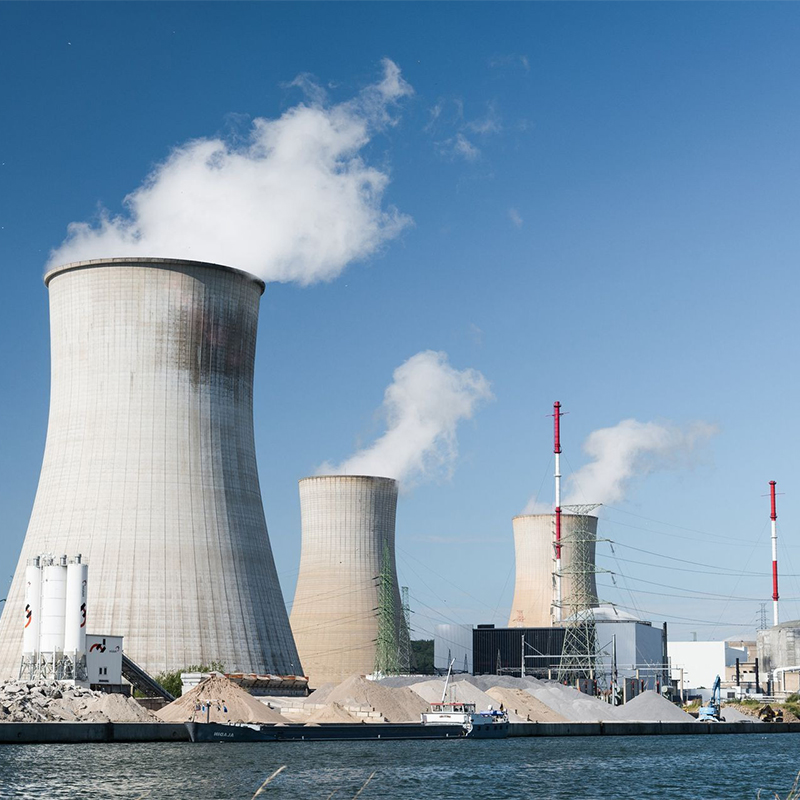
We Provide Cooling Tower Solution

Views: 0 Author: Cindy Publish Time: 2026-10-20 Origin: Site


Industrial steam condensation plays a vital role in power generation, chemical processing, petrochemical production, and other energy-intensive industries. In these applications, large quantities of heat must be removed continuously to maintain stable operating conditions, improve energy efficiency, and protect critical equipment. One important solution is the natural draught cooling tower, which uses buoyancy-driven airflow to cool circulating water without relying on large mechanical fans.
For industrial facilities with substantial and continuous heat-rejection requirements, natural draught cooling towers offer several potential advantages, including reduced fan power consumption, reliable operation, and suitability for large-scale installations. However, their performance depends on much more than tower height or cooling capacity. Thermal design, steam condenser conditions, ambient wet-bulb temperature, water distribution, and airflow resistance must all be considered.
In this article, Mach Industry (Zhejiang) Co., Ltd. explores the technical principles, design considerations, performance factors, and industrial applications of natural draught cooling towers for steam condensation.
A natural draught cooling tower is a heat-rejection system that relies on the natural movement of air to cool circulating water. Unlike mechanical draught cooling towers, which use fans to force or draw air through the structure, natural draught towers generate airflow through differences in air density and pressure.
In large installations, these towers often feature tall hyperbolic shells designed to support the required airflow and structural loads. They are commonly associated with power stations and other facilities where substantial cooling-water flow rates are necessary.
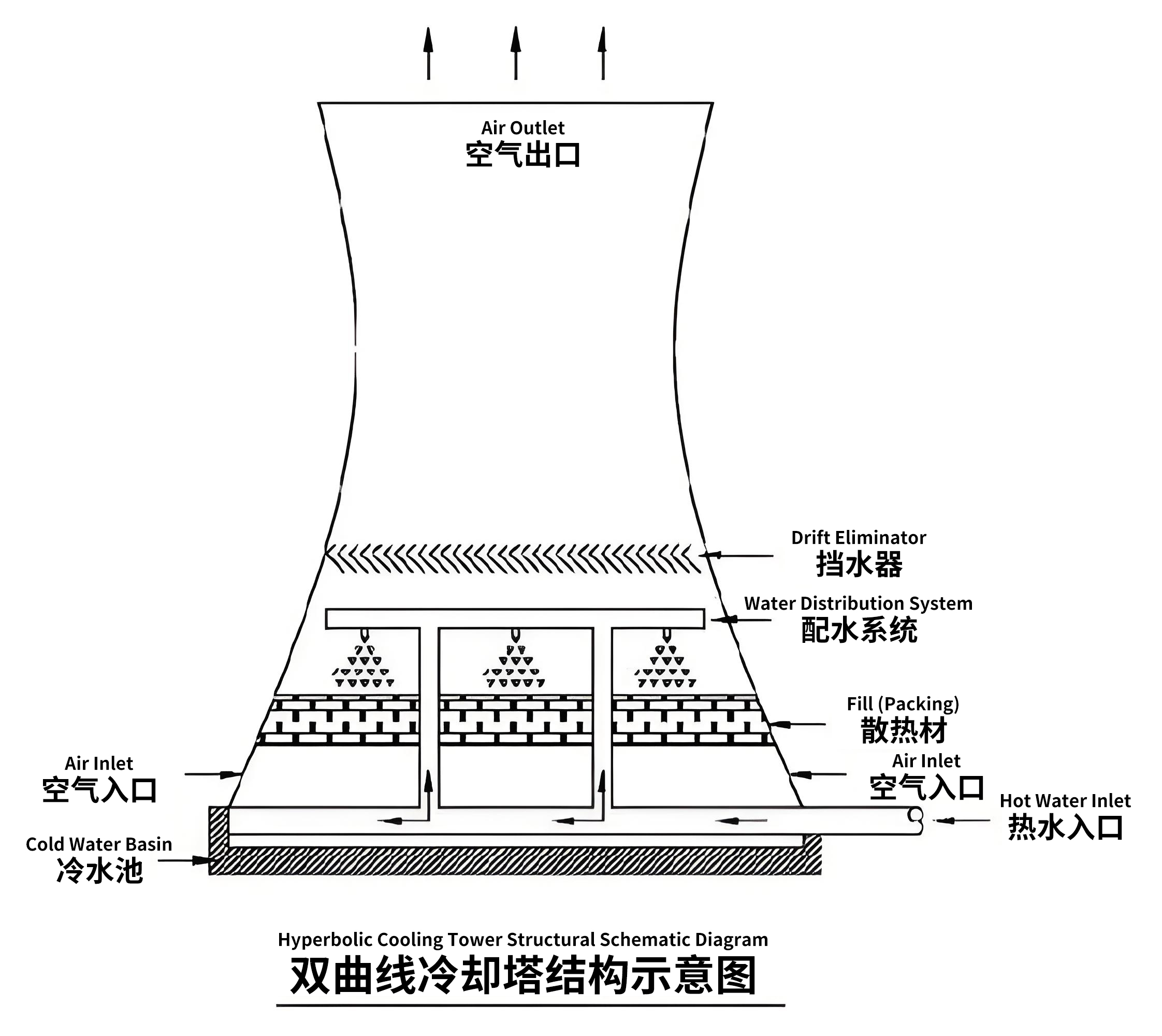
Their operating principle is straightforward: hot water enters the tower, transfers heat to the surrounding air, and returns to the process at a lower temperature. The warmed, moisture-laden air rises and leaves through the tower outlet, while cooler ambient air enters from below.
This continuous process supports industrial steam condensation by providing a source of cooled water for the condenser.
However, a natural draught cooling tower is not automatically the best choice for every industrial plant. Its suitability depends on the required cooling capacity, local climate, available land, capital budget, water availability, and long-term operating objectives.
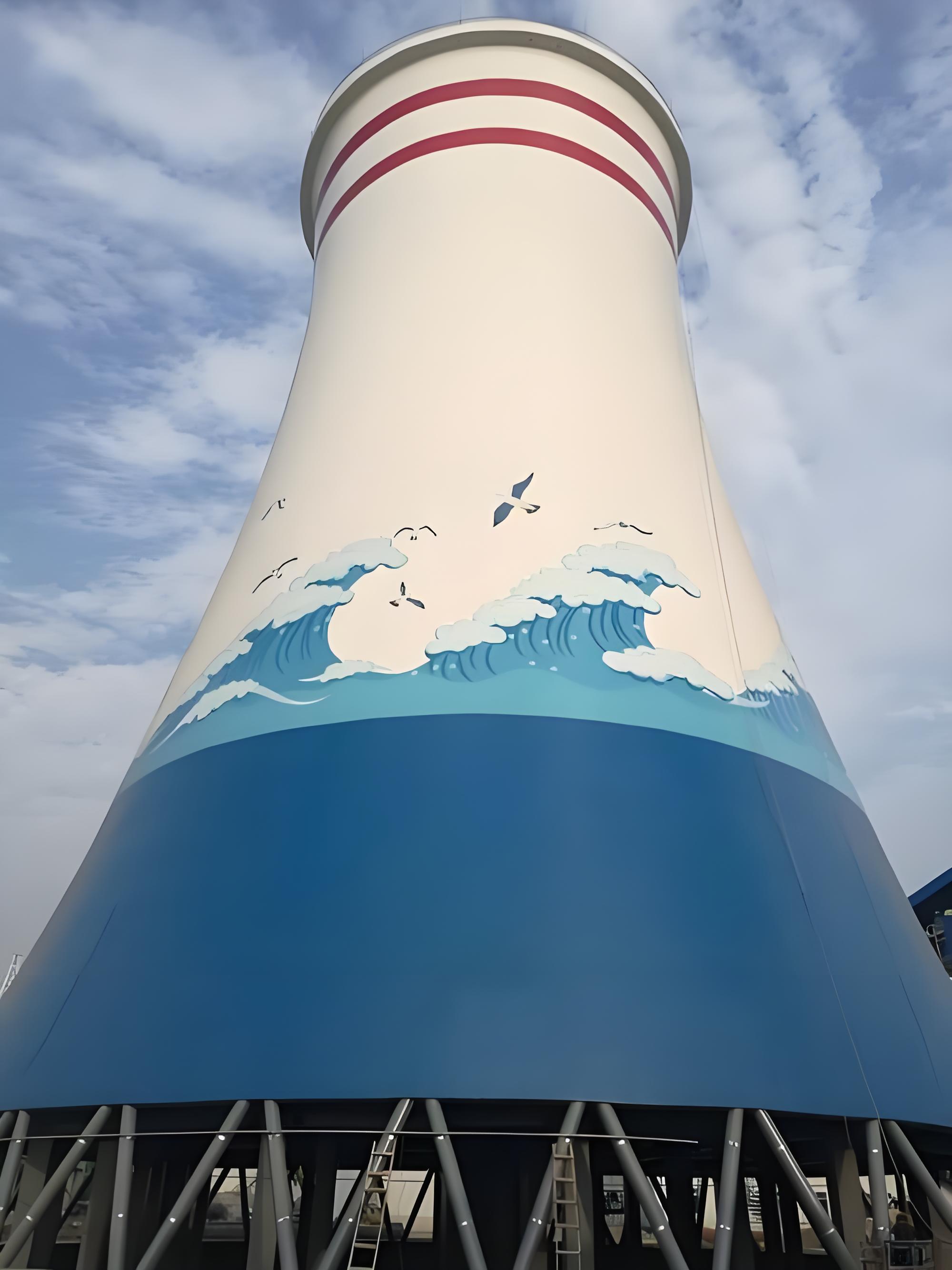
Steam condensation occurs when vapor releases heat and changes into liquid. In industrial steam cycles, this process is essential for recovering condensate, maintaining process stability, and supporting efficient energy conversion.
A typical steam turbine condenser uses cooling water flowing through a network of tubes. Exhaust steam contacts the outside surfaces of these tubes and releases heat as it condenses. The cooling water absorbs this energy and carries it away to the cooling tower.
The cooled water then returns to the condenser, completing the circulation loop.
This arrangement is widely used in thermal power generation and other industrial applications where steam must be condensed continuously.
The efficiency of the entire system depends on the performance of both the condenser and the cooling tower. If the cooling tower cannot maintain the required water temperature, condenser pressure may increase. In a steam turbine cycle, higher exhaust pressure can reduce turbine output and cycle efficiency.
For this reason, engineers should evaluate the cooling tower and steam condenser as interconnected components rather than treating them as independent systems.
Heat transfer in a surface condenser involves three primary processes.
First, steam releases latent heat as it condenses on the outside of the condenser tubes. Second, heat passes through the tube walls by conduction. Finally, the cooling water absorbs the heat through convection.
The overall heat-transfer rate depends on the available temperature difference, heat-transfer surface area, fluid flow conditions, tube material, and cleanliness of the heat-transfer surfaces.
Scale deposits, biological growth, suspended solids, and corrosion products can increase thermal resistance. Even when a cooling tower operates correctly, a fouled condenser may struggle to achieve the required condensation pressure.
Consequently, an effective industrial cooling strategy should include condenser inspection, water treatment, and performance monitoring alongside cooling tower design.
Cooling-water temperature directly affects condenser performance.
Under otherwise comparable operating conditions, lower cooling-water temperatures generally allow steam to condense at a lower pressure. This can improve turbine operating conditions and support better steam-cycle efficiency.
However, the achievable water temperature is limited by ambient conditions and the cooling tower's thermal performance.
In a wet cooling tower, the entering-air wet-bulb temperature is particularly important. During hot and humid weather, evaporative cooling becomes more challenging, and the cold-water outlet temperature may rise.
An industrial cooling system must therefore be designed around realistic local weather conditions rather than an ideal temperature that may occur only during a small portion of the year.
Natural draught cooling towers use buoyancy to create airflow. Inside the tower, air is heated and humidified through contact with the circulating water. Under suitable operating conditions, this air becomes less dense than the surrounding ambient air and rises through the tower.
As the warm air moves upward, cooler outside air enters through the lower openings. This creates a continuous airflow that supports heat and mass transfer.
Hot water from the condenser is distributed over the tower's heat-transfer zone. In wet cooling towers, the water contacts moving air across fill surfaces or other heat-transfer structures. A portion of the water evaporates, removing latent heat from the remaining water.
The cooled water collects in a basin or collection system before returning to the condenser.
Unlike a fan-driven tower, a natural draught tower does not require large fans to generate its primary airflow. Nevertheless, the circulating-water pumps and other auxiliary equipment still consume energy.
The chimney effect is the main driving force behind natural draught operation.
When air inside the tower becomes warmer and more humid than the outside air, its density can decrease. The resulting density difference produces a pressure head that drives air upward through the structure.
Several factors influence this process, including tower height, internal temperature conditions, ambient humidity, air density, and resistance along the airflow path.
Fill media, drift eliminators, structural elements, and water droplets can all contribute to pressure losses. If these losses become excessive, the available natural draught may not provide sufficient airflow for the required heat load.
Tower height and shell geometry must therefore be considered together with the internal cooling components.
A tall structure alone cannot guarantee high thermal performance. The complete tower must be designed to maintain a suitable balance between airflow, heat transfer, and resistance.
Natural draught cooling towers remove heat through both sensible heat transfer and evaporation.
Sensible heat transfer changes the temperature of the air and water. Evaporation removes additional energy when a portion of the liquid water changes into vapor.
Fill media improves the contact between air and water by spreading water into films or droplets. This increases the effective heat-transfer area and can improve cooling performance.
However, fill selection requires careful engineering. High-performance film fill may provide excellent heat transfer, but narrow passages can become vulnerable to blockage when circulating water contains suspended solids or biological contaminants.
Splash fill may be more suitable for some applications where fouling resistance is important.
The final selection should account for water quality, operating temperature, airflow resistance, maintenance requirements, and the characteristics of the complete cooling tower.
A natural draught cooling tower typically includes a structural shell or supporting framework, foundation, water distribution system, heat-transfer zone, air inlets, drift control equipment where required, and a cold-water collection system.
Additional equipment may include circulating-water pumps, pipelines, valves, instrumentation, water treatment facilities, and maintenance access platforms.
Each component contributes to overall performance and reliability.
For example, poor water distribution can reduce the effective heat-transfer area, while excessive resistance through the fill can limit airflow. Inadequate drift control can increase water losses, and structural deterioration can create long-term safety concerns.
Successful tower design requires these components to operate as an integrated system.
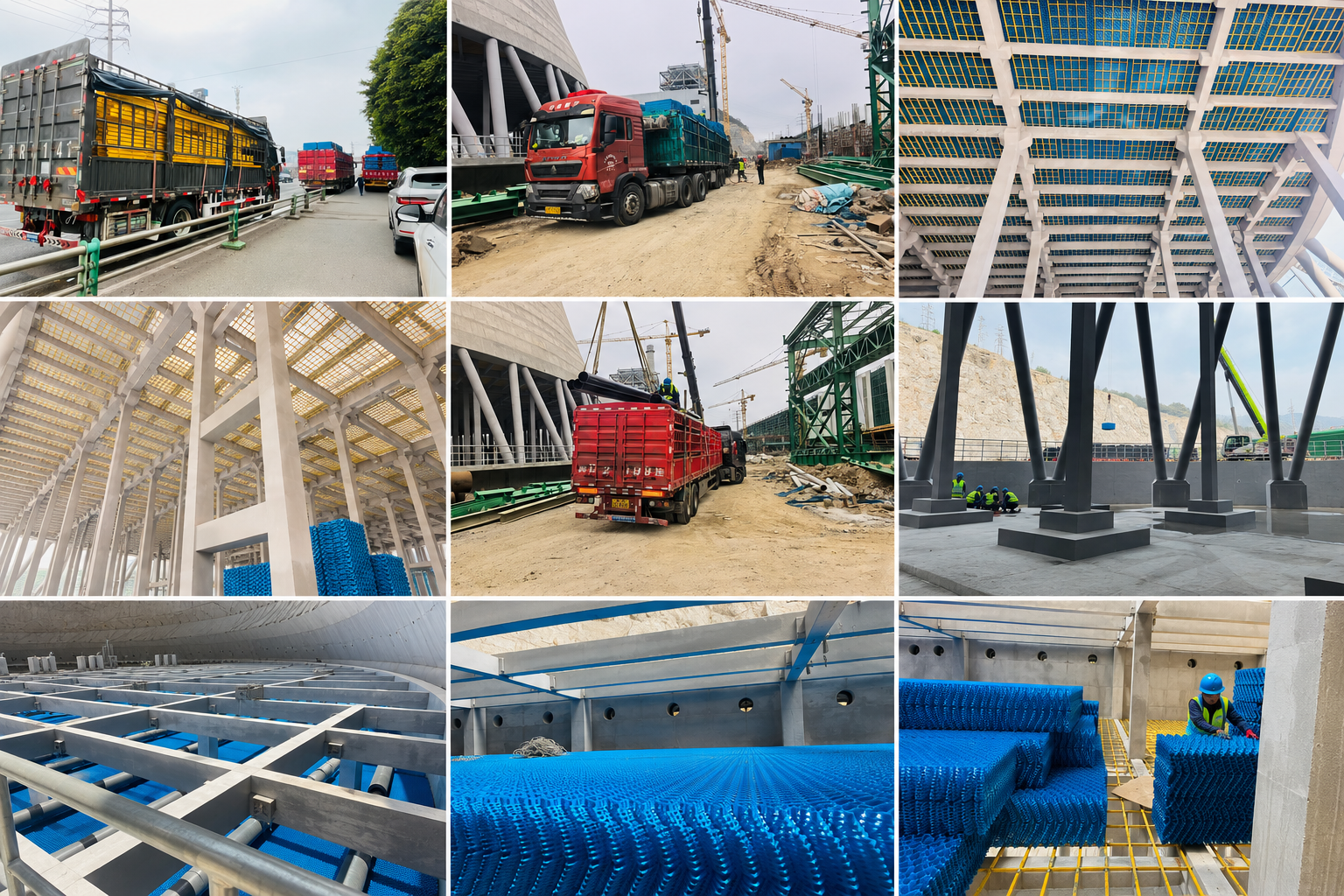
Large natural draught cooling towers often use reinforced-concrete hyperbolic shells. Their shape provides structural efficiency while supporting the airflow requirements of large cooling systems.
The foundation must transfer the structure's loads safely into the ground. Engineers must consider dead loads, wind forces, seismic conditions where applicable, temperature effects, material behavior, and local soil characteristics.
Construction quality and long-term inspection are equally important. Concrete cracking, surface deterioration, reinforcement corrosion, and drainage problems can affect structural durability.
Not every industrial cooling project requires a hyperbolic concrete tower. Smaller installations may be better served by other cooling tower configurations, depending on capacity, site restrictions, and economics.
The appropriate structure should be selected according to the project's actual engineering requirements.
The water distribution system should deliver hot water evenly across the available cooling area.
Uneven distribution can create dry zones, localized high water loading, and inefficient heat transfer. These problems reduce the effective performance of the tower and may create operational instability.
Fill media is equally important because it controls the contact area between air and water.
PVC film fill and polypropylene (PP) fill are used in suitable wet cooling tower applications. Splash fill may be preferred when the circulating water contains more suspended solids or when resistance to clogging is a major concern.
Material selection should consider operating temperature, water chemistry, mechanical strength, fouling potential, and cleaning procedures.
For natural draught systems, engineers must also consider pressure drop. Increasing the heat-transfer area is not beneficial if the additional airflow resistance significantly reduces the natural draught available to the tower.
Drift eliminators reduce the amount of liquid water carried out of a wet cooling tower with the exhaust air.
They help limit water loss and reduce the release of droplets that may contain dissolved minerals or water treatment chemicals.
Air inlets must also provide a relatively unobstructed path for incoming air. Nearby buildings, equipment, and other structures can affect local airflow and potentially cause warm exhaust air to return to the tower inlet.
This recirculation may increase the entering-air temperature and reduce cooling performance.
Proper site layout, drift control, and airflow design are therefore essential when planning a large natural draught cooling tower.
Thermal design begins with identifying the amount of heat that the cooling system must reject.
Engineers need accurate process information, including steam flow rate, condenser operating pressure, cooling-water flow, hot-water temperature, required cold-water temperature, and the expected range of plant loads.
The design must then determine whether the proposed tower can achieve the required cooling-water conditions under the selected ambient design conditions.
Other factors include seasonal weather variation, expected fouling, water availability, future capacity changes, and the acceptable condenser operating envelope.
Selecting a tower based only on a nominal capacity figure may lead to disappointing results if the actual site conditions differ from the rating conditions.
For circulating water, the heat-transfer rate can be estimated using the following equation:
Q = ṁ × Cp × (Tout − Tin)
Where:
Q is the heat-transfer rate.
ṁ is the water mass flow rate.
Cp is the specific heat capacity of water.
Tout − Tin is the temperature difference across the cooling system.
For water near typical cooling-system temperatures, the specific heat capacity is approximately 4.18 kJ/(kg·K).
For steam condensation, the total condenser heat load should be established from the process energy balance, including the latent heat released during condensation and any relevant sensible heat contributions.
The cooling tower must then be selected to reject the required heat under the specified design conditions.
Accurate heat-load calculations help prevent undersizing, unnecessary oversizing, and excessive operating costs.
Three parameters are particularly important when evaluating wet cooling tower performance.
Cooling range is the difference between the hot-water inlet temperature and the cold-water outlet temperature.
Cooling approach is the difference between the cold-water outlet temperature and the entering-air wet-bulb temperature.
Wet-bulb temperature represents a key measure of the atmosphere's evaporative cooling potential.
For example, if hot water enters the tower at 40°C and leaves at 30°C, the cooling range is 10°C. If the entering-air wet-bulb temperature is 26°C, the approach is 4°C.
A smaller approach generally requires a larger or more capable heat-transfer system and suitable airflow. Achieving it may increase equipment size and capital cost.
Engineers should evaluate range, approach, and wet-bulb temperature together rather than relying on one parameter to determine cooling tower quality.
Consider an industrial plant circulating 5,000 tonnes of water per hour and cooling it from 40°C to 30°C.
Assuming a water density of approximately 1,000 kg/m³ and a specific heat capacity of 4.18 kJ/(kg·K), the estimated water-side heat rejection is approximately 58 MW.
This example illustrates the scale of the thermal duty involved in a large industrial cooling system.
It does not establish the size or performance rating of a particular natural draught cooling tower. Actual equipment selection requires consideration of the design wet-bulb temperature, airflow, tower geometry, water distribution, heat-transfer characteristics, and operating conditions.
For steam-condensation projects, the final design should also be checked against the condenser's required pressure and cooling-water operating range.
Natural draught cooling tower performance depends on whether buoyancy-driven airflow can support the required heat and mass transfer.
The water-to-air mass-flow ratio affects cooling behavior, while the resistance of the fill and drift eliminators influences the available airflow.
If the tower has excessive internal resistance, its natural draught may not be sufficient to deliver the required cooling performance.
Engineers can use established thermal design methods and validated simulation tools to evaluate these interactions. Computational fluid dynamics (CFD) may help identify airflow maldistribution, recirculation, and localized performance problems.
However, simulation results should be supported by appropriate engineering calculations, reliable input data, and performance verification.
Cooling tower performance is influenced by multiple factors that interact with one another.
Ambient weather affects the potential for evaporative cooling. Water flow influences heat transfer and distribution. Fill condition affects the contact area between air and water, while condenser cleanliness determines how effectively heat passes from steam into the cooling water.
A problem in any of these areas may increase condenser pressure or reduce plant output.
For this reason, troubleshooting should begin with an assessment of the entire cooling system rather than an immediate assumption that the tower itself is undersized.
The entering-air wet-bulb temperature is one of the most important design conditions for a wet cooling tower.
When wet-bulb temperature rises, achieving a low cold-water outlet temperature becomes more difficult.
A tower that performs well in cool weather may experience higher outlet water temperatures during hot and humid periods.
Engineers should use representative site weather data when selecting the design condition. They should also consider the effects of prevailing winds, nearby heat sources, and possible recirculation of exhaust air.
Understanding seasonal variation helps operators establish realistic performance expectations and develop appropriate operating strategies.
The cooling-water flow rate must remain within the operating limits of the condenser, distribution system, and tower.
Insufficient flow can reduce heat transfer and create uneven water distribution. Excessive flow may increase pumping costs or exceed the capacity of distribution equipment.
Water quality is another major consideration.
Hardness, alkalinity, suspended solids, chlorides, and biological activity can contribute to scaling, corrosion, and fouling. These problems may affect both the tower and the condenser.
A suitable water treatment program should include regular monitoring, controlled blowdown, cleaning where necessary, and filtration when justified by the water conditions.
Maintaining water quality helps preserve heat-transfer performance and extend equipment service life.
Tower height, diameter, and internal configuration influence airflow, water loading, and heat-transfer capacity.
Increasing tower height may increase the available buoyancy-driven pressure head, but it also raises structural requirements and construction costs.
Tower diameter influences the available cross-sectional area and the distribution of air and water.
Fill selection must balance heat-transfer performance against airflow resistance and fouling risk.
The best design is not necessarily the tallest tower or the fill with the greatest nominal surface area. It is the arrangement that delivers the required thermal performance under actual operating conditions at an acceptable lifecycle cost.
Natural draught and mechanical draught cooling towers serve similar heat-rejection purposes, but they operate differently.
Natural draught towers rely primarily on buoyancy-driven airflow. Their lack of large tower fans can reduce fan-related energy consumption and eliminate certain fan maintenance requirements.
Mechanical draught towers use fans to move air through the cooling zone. Depending on the design, they may offer greater flexibility in airflow control, modular installation, and capacity expansion.
For large power plants with substantial continuous cooling loads, a natural draught tower may be attractive when land, climate, and project economics support its use.
For smaller industrial facilities, mechanical draught equipment may provide a more practical combination of footprint, controllability, and initial investment.
The comparison should include capital expenditure, pumping and fan power, water consumption, maintenance, reliability, construction time, and the consequences of equipment downtime.
Natural draught cooling towers are not universally more efficient or less expensive. Their advantages depend on the complete project and operating requirements.
Natural draught cooling towers are particularly relevant to large facilities with continuous heat-rejection requirements.
Typical applications include:
Thermal power stations with steam turbine condensers.
Large industrial utility systems.
Selected petrochemical and chemical processing facilities.
Industrial plants with substantial continuous cooling-water circulation.
Successful integration requires coordination between the cooling tower, condenser, pumps, pipelines, water treatment equipment, and plant control system.
Engineers should confirm that the cooling-water flow rate and temperature range are compatible with condenser requirements. Basin levels, pump operating conditions, pipeline pressure losses, and control sequences must also be considered.
For facilities with variable process loads, the design should account for expected operating changes rather than assuming constant full-load operation.
Where site space is limited or cooling demand is relatively modest, another cooling tower configuration may provide a better overall solution.
Natural draught cooling towers can reduce the need for large fan motors, but total system energy consumption also includes circulating-water pumps, treatment equipment, and other auxiliaries.
Improved condenser cooling may support better steam-cycle performance, depending on turbine characteristics and operating conditions.
Environmental considerations are equally important.
Wet cooling towers consume water through evaporation and blowdown, while drift may carry small quantities of liquid droplets out of the tower. Water sourcing, chemical treatment, wastewater management, and plume visibility may all affect project planning.
In water-stressed locations, engineers should evaluate water availability alongside thermal performance. Dry or hybrid cooling systems may be worth considering when water conservation is a priority, although they have different capital costs, energy requirements, and ambient-temperature limitations.
A sound engineering decision balances thermal performance, energy use, water consumption, environmental requirements, and long-term operating costs.
Industrial cooling towers may experience reduced cooling capacity, uneven water distribution, scaling, biological growth, excessive drift, and unexpected increases in condenser pressure.
Effective troubleshooting begins with accurate operating measurements.
Operators should compare hot-water and cold-water temperatures, entering-air wet-bulb temperature, cooling-water flow, condenser pressure, and available pressure-drop readings against established operating baselines.
If cooling performance declines, inspections may be needed to check distribution equipment, fill condition, air inlets, and condenser tube cleanliness.
It is important not to assume that every high-temperature problem originates in the cooling tower.
A malfunctioning instrument, blocked strainer, pump issue, condenser fouling, or unexpected change in process load may create similar symptoms.
A systematic diagnosis can identify the real cause and prevent unnecessary equipment replacement.
A planned maintenance program helps preserve cooling performance and reduce unplanned shutdowns.
Routine inspections should cover water distribution, fill condition, drift eliminators, basin cleanliness, water chemistry, and relevant structural components.
Operators should record important performance data and compare it over time. Gradual increases in cooling-water outlet temperature or condenser pressure may indicate developing problems that warrant investigation.
For large reinforced-concrete towers, periodic structural inspections should assess cracking, surface deterioration, drainage, and signs of reinforcement corrosion.
Maintenance work must follow site-specific isolation, access, and safety procedures.
Condition-based maintenance can help industrial facilities identify deterioration early, plan repairs more effectively, and improve long-term equipment reliability.
Selecting a natural draught cooling tower requires a detailed assessment of process requirements and site conditions.
Before comparing equipment options, engineers should establish the following information:
Required heat-rejection capacity.
Condenser cooling-water flow rate.
Hot-water inlet and cold-water outlet temperatures.
Design wet-bulb temperature and relevant weather data.
Site elevation and available construction area.
Water availability and expected water quality.
Structural, seismic, wind, and environmental requirements.
Maintenance access and expected operating life.
The next step is to compare suitable cooling tower configurations based on thermal performance, initial investment, operating costs, water consumption, maintenance requirements, and construction constraints.
Request technical documentation showing the design conditions, expected cooling performance, water consumption, pressure losses, materials, and maintenance requirements.
For very large natural draught towers, structural engineering and civil construction requirements should be clearly coordinated with the cooling system design.
An integrated evaluation helps ensure that the selected equipment can meet the actual process requirements rather than simply matching a nominal capacity figure.
Mach Industry (Zhejiang) Co., Ltd. focuses on industrial cooling tower solutions and related cooling equipment.
For projects involving steam condensation, equipment selection should begin with a clear understanding of the required heat load, cooling-water conditions, ambient design temperature, site limitations, and operating objectives.
These parameters help determine which cooling tower configuration is appropriate for the application.
Natural draught towers, particularly large hyperbolic structures, require specialized structural and thermal engineering. The responsibilities for tower design, civil works, water distribution, performance guarantees, and commissioning should therefore be clearly defined for each project.
Mach Industry can be contacted to discuss industrial cooling requirements, available cooling tower configurations, materials, and equipment suitability.
For buyers evaluating a cooling tower project, providing accurate process data is an important first step toward a practical technical assessment.
Visit the official website of Mach Industry (Zhejiang) Co., Ltd. at https://www.machcooling.com to learn more about its cooling tower solutions and contact the company regarding your application.
Natural draught cooling tower technology continues to benefit from developments in thermal modeling, materials, monitoring, and water management.
Digital monitoring systems can help operators track cooling-water temperatures, flow rates, ambient conditions, water chemistry, and condenser pressure. By analyzing these parameters together, plant teams can identify performance deterioration and investigate potential problems earlier.
Advanced thermal modeling can also help engineers assess tower performance under different operating loads and weather conditions.
Improvements in water treatment and fill materials may reduce fouling and simplify maintenance in suitable applications.
However, the benefits of these technologies depend on reliable data and appropriate engineering. Digital monitoring cannot compensate for an incorrectly sized tower, poor water distribution, or inadequate condenser maintenance.
The most effective approach combines sound fundamental design with practical operating data and a disciplined maintenance strategy.
Natural draught cooling towers can provide an effective heat-rejection solution for large industrial steam-condensation systems when site conditions, thermal requirements, and project economics align.
Their performance depends on buoyancy-driven airflow, efficient water distribution, suitable heat-transfer surfaces, reliable condenser operation, and effective water management. Engineers must also account for ambient wet-bulb temperature, airflow resistance, structural requirements, and long-term maintenance.
The key to successful equipment selection is to evaluate the cooling tower and condenser as an integrated system. Accurate heat-load calculations, realistic design conditions, and appropriate performance verification help ensure that the selected equipment meets industrial operating requirements.
For companies planning industrial cooling projects, Mach Industry (Zhejiang) Co., Ltd. is a contact for discussing cooling tower requirements and available equipment solutions.
Visit https://www.machcooling.com to explore Mach Cooling's industrial cooling solutions and discuss your project requirements.
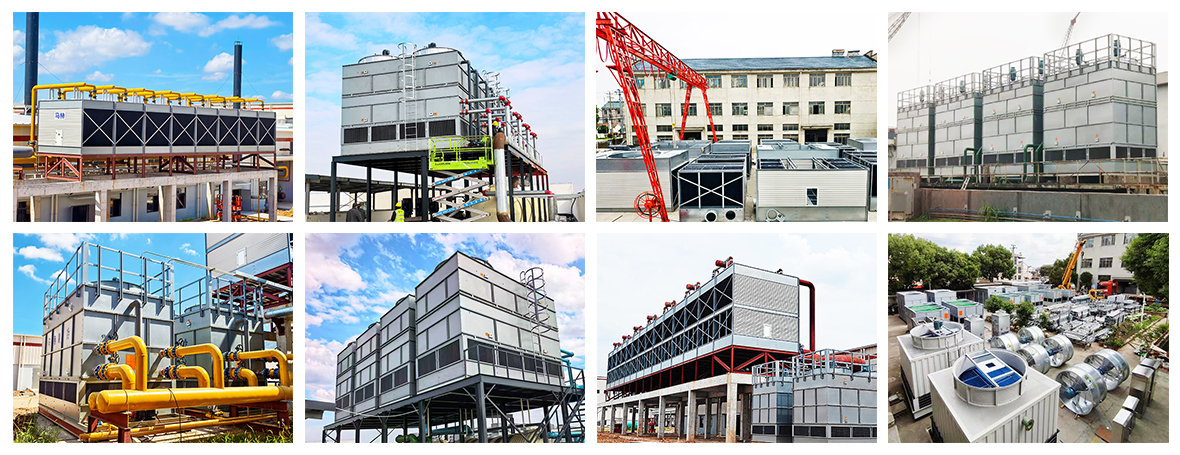
A natural draught cooling tower uses buoyancy-driven airflow to cool circulating water. It does not rely on large mechanical fans to generate its primary airflow.
The tower cools water that circulates through a steam condenser. The water absorbs heat from the exhaust steam, allowing the steam to condense before the water returns to the cooling tower.
Its primary advantage is the ability to generate airflow without large tower fans. This can reduce fan-related electricity consumption and fan maintenance requirements in suitable large-scale applications.
Important factors include heat load, wet-bulb temperature, tower geometry, water flow, airflow resistance, fill characteristics, water distribution, and condenser cleanliness.
No. Natural draught towers are generally most attractive for large cooling loads where site conditions and project economics justify their design and construction requirements. Smaller facilities may benefit more from mechanical draught or other cooling systems.
Start by measuring cooling-water temperatures, flow rates, ambient wet-bulb temperature, and condenser pressure. Inspect water distribution, fill condition, condenser cleanliness, and water quality before deciding whether equipment modifications are necessary.
Visit https://www.machcooling.com to learn about Mach Cooling's industrial cooling tower solutions and contact the company to discuss your application requirements.