We Provide Cooling Tower Solution

Views: 0 Author: Cindy Publish Time: 2026-10-09 Origin: Site


Installing a cooling tower is not simply a matter of placing the equipment on a concrete foundation, connecting a few pipes, and switching on the fan. A cooling tower is part of a larger thermal system, and every component—from the foundation and piping to the fill, fan, motor, electrical controls, and water distribution system—has to work together.
In this cooling tower installation guide, we will walk through the major installation steps, technical requirements, common mistakes, commissioning procedures, and best practices.
Whether you are installing a new industrial cooling tower or replacing an existing unit, getting the installation right from day one can make a major difference in cooling performance, energy consumption, reliability, and maintenance costs.
A cooling tower may look like a straightforward piece of industrial equipment, but installation is actually a system-engineering task.
Think of the tower as a team. The fan provides airflow, the fill creates heat-transfer surface, the water distribution system spreads hot water, and the foundation and piping keep everything physically stable.
If one member of the team fails, the entire system feels it.
A poorly installed tower can suffer from low cooling capacity, excessive vibration, uneven water distribution, high energy consumption, water leakage, and premature component wear.
That is why installation should begin with planning—not with a crane.
Before equipment arrives at the site, confirm the complete project requirements. At a minimum, you should review:
Cooling capacity and design heat load
Circulating water flow
Entering and leaving water temperatures
Ambient design conditions
Cooling tower dimensions
Foundation dimensions and loading
Inlet and outlet pipe locations
Electrical requirements
Fan and motor specifications
Maintenance access
Local building and electrical requirements
Environmental and noise requirements
Site selection should also consider airflow, noise, plume, drift, structural support, rigging access, and future maintenance.
The cooling tower manufacturer's drawings should be treated as an essential installation document, not optional paperwork.

The location of the cooling tower has a direct effect on its performance.
A tower needs access to sufficient fresh ambient air. Nearby buildings, walls, exhaust outlets, other cooling towers, or large structures can interfere with airflow and cause hot discharge air to recirculate back into the air inlet.
When this happens, the tower may continue running normally while its actual cooling capacity decreases.
The installation location should therefore provide sufficient space around air inlets and discharge areas. The design should also consider prevailing wind conditions and the possibility of warm-air recirculation.
A good rule is simple: give the cooling tower room to breathe.
The foundation is literally where the entire cooling tower begins.
It must be strong, stable, level, and designed to support the tower under actual operating conditions.
Remember that the tower does not carry only its dry weight. The operating load can include basin water, internal components, piping loads, fan equipment, and dynamic forces.
Before installation, verify:
Foundation dimensions
Surface levelness
Anchor bolt positions
Embedded plates
Structural strength
Drainage provisions
Vibration-control requirements
Do not force the tower to fit an inaccurate foundation.
Correcting a foundation before installation is inconvenient. Correcting it after the tower, piping, and electrical systems are already installed can become a very expensive problem.
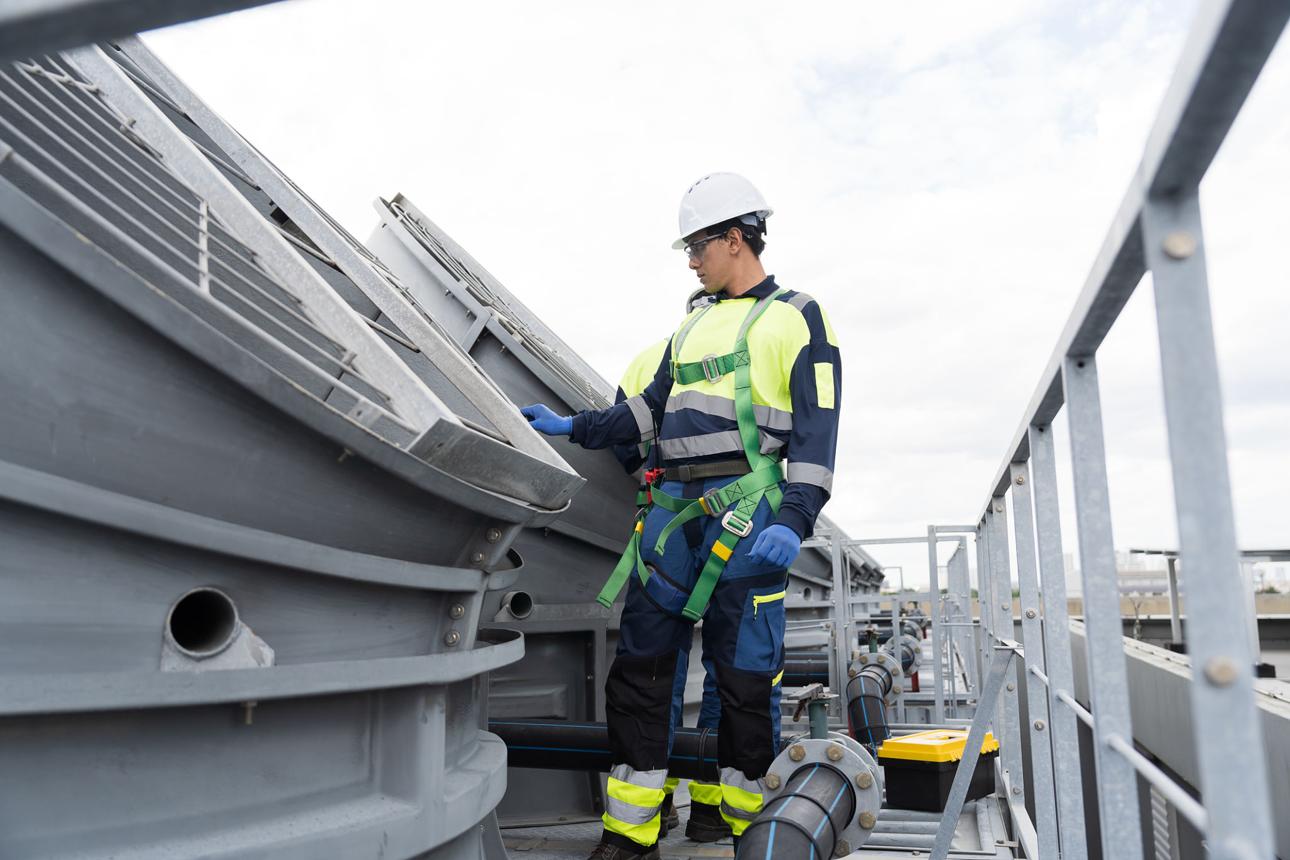
A cooling tower should always have enough space for future maintenance.
Leave adequate access for:
Fan and motor inspection
Fill replacement
Nozzle cleaning
Basin cleaning
Valve operation
Electrical maintenance
Gearbox servicing
Component replacement
A tower that fits perfectly into a small space may still be a poor installation if technicians cannot safely reach the equipment.
Ask yourself one practical question:
Can a technician maintain this tower five years from now without dismantling half the plant?
If the answer is no, the layout needs another look.
A typical cooling tower installation process follows this general sequence:
Foundation inspection → tower positioning → structural assembly → fill installation → water distribution → piping connections → fan and motor installation → electrical connections → system flushing → commissioning.
The exact sequence can vary depending on the tower design.
A factory-assembled package may require relatively little field assembly, while a large industrial or field-erected cooling tower may require extensive site construction.
The key is to follow the manufacturer's installation drawings and procedures rather than improvising connections in the field.
Before lifting or assembling anything, inspect the delivered equipment against the approved drawings and packing list.
Confirm the:
Cooling tower model
Overall dimensions
Connection locations
Fan assembly
Motor
Fill packs
Drift eliminators
Spray nozzles
Water distribution pipes
Fasteners
Electrical components
Accessories
Also inspect the equipment for transportation damage.
Missing or damaged components should be identified before installation rather than discovered halfway through assembly.
Measure the foundation before placing the tower.
Check the dimensions, elevation, flatness, anchor bolt locations, embedded plates, drainage provisions, and structural condition.
The foundation should be accepted before tower erection begins.
If the foundation is out of tolerance, correcting it at this stage is much easier and cheaper than attempting to correct the problem after the tower has been assembled.
Depending on the design, the cooling tower may arrive factory assembled, partially assembled, or as field-erected sections.
Use the specified lifting points and appropriate rigging equipment.
Position each section carefully and avoid dragging structural or panel components across the foundation.
For multi-cell cooling towers, make sure the individual cells are correctly aligned and securely connected.
All structural connections should be tightened according to the manufacturer's requirements.
At this stage, also verify that the tower has sufficient clearance from nearby structures.
Cooling tower fill is one of the most important heat-transfer components.
Film fill creates a large surface area over which water flows, allowing increased contact between air and water.
Splash fill works differently by breaking water into droplets and promoting repeated contact between water and airflow.
During installation, make sure:
Fill packs are correctly positioned.
Sheets are not crushed.
Fill orientation is correct.
Supports are properly installed.
Unnecessary gaps are avoided.
Water can distribute evenly.
The fill material is suitable for the operating temperature.
The fill material is compatible with the water quality.
A small installation error inside the fill section can have a surprisingly large impact on thermal performance.
The water distribution system must spread hot water evenly over the fill.
Depending on the cooling tower design, this may include:
Distribution pipes
Headers
Spray nozzles
Hot-water basins
Valves
Strainers
Flow-control components
Uneven distribution creates dry areas in the fill while overloading other areas.
The result?
Part of the tower works hard while another part barely contributes.
Before startup, inspect all nozzles and distribution pipes for construction debris. A blocked nozzle can create a surprisingly large performance problem.
Cooling tower piping connects the tower to the rest of the process system, so incorrect piping can compromise the entire installation.
Pipe diameter should be selected according to the required water flow and acceptable pressure loss.
Pipe supports should prevent excessive mechanical loads from being transferred to the tower connections.
Thermal expansion should also be considered, particularly in systems operating with significant temperature changes.
Where required, the piping system should include:
Isolation valves
Strainers
Balancing valves
Pressure measurement points
Temperature measurement points
Drain valves
Makeup-water connections
Blowdown connections
Flexible connectors
Good piping is not simply about getting water from Point A to Point B.
It is about getting the right amount of water to the right place at the right pressure.
The fan is the engine of the air side of the cooling tower.
During installation, carefully check:
Fan blade orientation
Blade clearance
Hub assembly
Shaft alignment
Motor mounting
Belt tension where applicable
Gearbox condition where applicable
Lubrication
Safety guards
Before energizing the motor, rotate the fan manually where safe and practical to confirm that there is no physical interference.
Once powered, verify the rotation direction.
A fan rotating in the wrong direction may still make plenty of noise, but it will not provide the airflow the tower needs.
Modern cooling towers can include motors, variable frequency drives, temperature sensors, vibration sensors, water-level controls, alarms, and PLC-based control systems.
Before energizing the system, verify:
Motor voltage
Phase
Current
Grounding
Overload protection
Emergency-stop functions
VFD parameters
Sensor wiring
Control interlocks
Alarm functions
Electrical installation should always be performed by qualified personnel according to applicable electrical standards and project requirements.
For energy-conscious industrial facilities, a VFD can also help match fan speed to actual cooling demand instead of operating the fan at full speed all the time.
Piping should be designed as part of the cooling system—not added as an afterthought.
Keep pipe routing practical, minimize unnecessary fittings, provide adequate supports, and ensure valves remain accessible.
Where appropriate, the piping system should allow for thermal expansion and contraction.
Flexible connections may be required where vibration isolation or movement needs to be accommodated.
For multi-cell cooling towers, balancing is particularly important. Uneven water flow can cause one cell to carry excessive thermal load while another operates below its intended capacity.
An open cooling tower continuously loses water through evaporation, drift, and blowdown.
The makeup-water system restores the required basin level.
The blowdown system removes concentrated dissolved solids from the circulating water.
Both systems should have accessible valves and appropriate controls.
Poor water management can eventually lead to:
Scale formation
Corrosion
Biological growth
Blocked nozzles
Fouled fill
Reduced heat-transfer performance
So water treatment should be considered part of cooling tower operation from the beginning.
Drainage is easy to overlook during installation, but it becomes extremely important during maintenance, heavy rainfall, shutdowns, and emergency conditions.
Connect basin drains and overflow lines according to the project design.
Make sure low points in the piping can be drained where necessary.
The drainage route should also prevent standing water from accumulating around the tower foundation.
Electrical installation is more than connecting a motor to a power supply.
The complete system should be checked for:
Correct voltage
Correct phase
Motor protection
Grounding
Disconnects
Motor starters or VFDs
Temperature sensors
Water-level controls
Alarm systems
Emergency stops
Control interlocks
Before energizing the equipment, verify all electrical connections and confirm that control logic operates correctly.
Commissioning is where installation becomes operation.
Before introducing the full process load, inspect the complete cooling tower mechanically, electrically, and hydraulically.
First, flush the piping system to remove construction debris.
Then clean the basin and strainers.
Next, verify valve positions.
After that, confirm the fan rotates in the correct direction.
Finally, gradually introduce water and monitor the system.
Pay close attention to:
Water leakage
Water distribution
Basin level
Fan rotation
Motor current
Vibration
Noise
Water temperature
Airflow
Never treat the first startup as a simple “on/off” event.
It is a controlled test of the entire cooling system.
Inspect:
Structural bolts
Supports
Fan assemblies
Motors
Gearboxes
Shafts
Belts
Fill packs
Drift eliminators
Louvers
Access panels
Check for abnormal vibration and unusual noise.
Make sure all guards are installed around rotating equipment.
Any mechanical issue discovered during no-load testing should be corrected before full operation.
Start the circulation system gradually.
Observe:
Basin water level
Spray pattern
Distribution uniformity
Pump operation
Water leakage
Nozzle performance
Inspect nozzles for blockage and confirm that water reaches the intended fill areas.
For multi-cell towers, confirm that each cell receives the correct flow.
Unequal flow can cause one cell to carry too much thermal load while another contributes less than expected.

Once stable water flow and airflow are established, record:
Entering-water temperature
Leaving-water temperature
Ambient wet-bulb temperature
Water flow
Fan speed
Motor load
The cooling range is the difference between hot-water and cold-water temperatures.
The approach is the difference between cold-water temperature and ambient wet-bulb temperature.
These measurements provide a useful baseline for evaluating cooling tower performance under actual operating conditions.
Many cooling tower problems are not caused by defective equipment.
They are caused by small installation mistakes.
Common examples include:
Poor foundation leveling
Incorrect anchor positions
Unsupported piping
Incorrect fill installation
Blocked nozzles
Incorrect fan rotation
Poor electrical grounding
Insufficient maintenance clearance
Restricted airflow
Uneven water distribution
Each problem may seem minor.
Together, however, they can significantly reduce cooling performance.
An uneven foundation can create structural stress and alignment problems.
It can also complicate basin operation and mechanical connections.
Always verify the foundation before installation instead of trying to compensate for major errors with improvised shims or forced connections.
Oversized or undersized pipes, excessive fittings, inadequate supports, poor valve placement, and insufficient expansion allowance can create pressure loss, vibration, uneven flow, and mechanical stress.
The piping system should be designed around the required flow rate and operating conditions.
A cooling tower needs air just as much as it needs water.
Installing the tower in a confined area or allowing hot discharge air to recirculate can raise the temperature of the air entering the tower.
That can increase the approach temperature and reduce cooling capacity.
This is why installation location matters so much.
The tower needs room to breathe.
Fill is often hidden once the cooling tower is fully assembled, which makes installation errors particularly difficult to notice.
Incorrect orientation, excessive compression, missing supports, or unsuitable fill material can reduce heat transfer and increase maintenance problems.
Always install fill according to the manufacturer's specifications.
Safety should be built into every stage of the installation.
During lifting operations, use suitable cranes, rigging equipment, exclusion zones, and qualified personnel.
During elevated work, use appropriate fall-protection systems.
During electrical work, use proper isolation and lockout/tagout procedures.
During fan installation, make sure rotating equipment cannot accidentally start.
The installation team should also consider site-specific wind, structural, seismic, electrical, fire, environmental, and occupational safety requirements.
A successful cooling tower installation should continue delivering reliable performance years after commissioning.
Regular maintenance should include:
Inspecting cooling tower fill
Cleaning nozzles
Monitoring water quality
Checking basin conditions
Inspecting fans
Checking motors
Monitoring vibration
Inspecting belts or gearboxes
Checking electrical connections
Recording operating temperatures
Performance data is especially valuable.
If the cold-water temperature gradually increases under similar weather and load conditions, it may indicate early signs of fouling, poor water distribution, fan problems, fill deterioration, or other operating issues.
The earlier you identify the trend, the easier the problem is to solve.
For industrial projects, choosing the right cooling tower manufacturer is just as important as following the installation procedure.
Mach Industry (Zhejiang) Co.,Ltd approaches cooling tower projects from both the equipment and system perspective.
A successful installation starts before the tower reaches the job site.
The cooling tower should be matched to the required heat load, water flow, ambient conditions, installation space, structural requirements, water quality, and operating environment.
Mach provides industrial cooling tower solutions designed around project-specific requirements rather than relying on a one-size-fits-all approach.
For industrial buyers, this approach can make equipment selection, installation planning, commissioning, and long-term maintenance much easier.
You can learn more about Mach Industry (Zhejiang) Co.,Ltd through its official website: Mach Industry (Zhejiang) Co.,Ltd

Before final handover, use this practical checklist.
Correct dimensions
Level surface
Correct anchor positions
Adequate structural capacity
Correct assembly
Secure bolts
Proper clearances
Accessible service areas
Correct fill type
Correct orientation
Proper support
No damaged sections
Correct nozzle positions
Clean distribution pipes
Balanced water flow
No leakage
Correct pipe sizing
Adequate supports
Thermal expansion allowance
Accessible valves
Proper drains
Correct rotation
Proper clearance
Correct alignment
No abnormal vibration
Safety guards installed
Correct voltage
Grounding completed
Protection devices installed
VFD programmed where applicable
Controls tested
System flushed
Basin cleaned
Water flow verified
Temperatures recorded
Motor load checked
Vibration checked
Approved drawings
Installation records
Commissioning data
Operation manuals
Maintenance instructions
A successful cooling tower installation is about much more than assembling equipment.
The foundation provides stability. The piping delivers water. The distribution system spreads that water across the fill. The fill provides the heat-transfer surface. The fan provides airflow. The electrical and control system coordinates the operation.
Every component has a job.
If one part is installed incorrectly, the entire system can suffer.
That is why the best approach is to treat cooling tower installation as an integrated engineering process—from site selection and foundation preparation to piping, electrical connection, commissioning, and long-term maintenance.
With careful planning and professional installation, an industrial cooling tower can provide reliable heat rejection, stable operating temperatures, and efficient performance for many years.
For industrial users planning a new cooling tower project, working with an experienced manufacturer such as Mach Industry (Zhejiang) Co.,Ltd can help ensure that equipment selection, installation requirements, and long-term operating needs are considered together from the beginning.